How to Play Jack-Nine Suited (J9s)
Jack-nine suited is a strong one-gapper that flops big draws and disguised straights. Here is how to open, 3-bet bluff, and play J9s postflop.
On this page · 6 sections
Jack-nine suited (J9s) is a one-gap suited connector — a hand that sits just below the elite JTs but keeps most of what makes suited connectors valuable. It flops straight draws, flush draws, and playable top pairs, and it wins about 55% heads-up against a random hand. The single gap between the jack and nine costs it a bit of straight potential and creates a few more dominated situations, so J9s is a strong hand you play in fewer seats and with a touch more caution.
Open from middle position onward
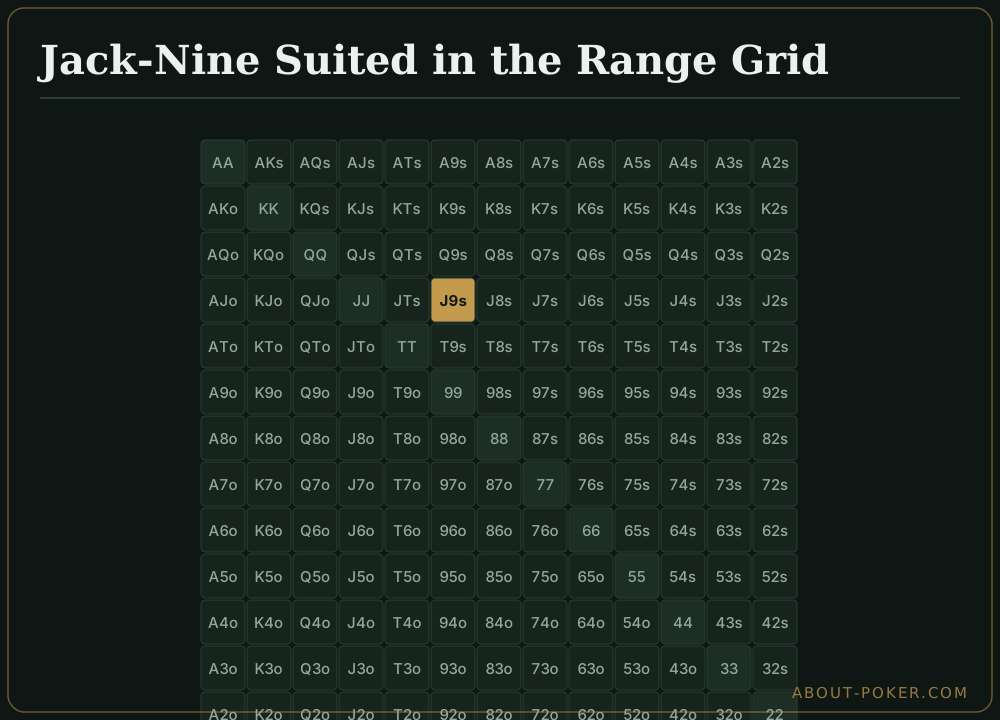
J9s is a standard open from middle position, cutoff, button, and the small blind, but usually a fold under the gun in 6-max because too many players remain behind. The suitedness and connectedness give it the playability to open once the table starts folding to you, but it is not strong enough to fight through a full field from the earliest seat. Lean on your preflop opening ranges to see exactly where it enters, and open it aggressively once you reach late position.
The gap matters. Where jack-ten suited makes four different straights, J9s makes fewer, and its straights are slightly more disguised but also slightly less frequent. That is why it drops a seat or two in the opening range.
A useful 3-bet bluff
J9s works well as an occasional 3-bet bluff, particularly from the button and blinds against late-position opens. It has good equity when called, plays fine postflop, and its jack and nine block some of the jack-x, nine-x, and pocket-nine combinations your opponent might hold. It is a step below JTs in priority, so use it to round out a 3-bet range rather than as your first-choice bluff.
A worked example
You hold J♥9♥ on the button. The cutoff opens to 2.5bb and you call. The flop comes T♠-8♦-3♥.
This is exactly the flop J9s is built for: an open-ended straight draw with any queen or seven completing the nuts on one end and a strong straight on the other. You have roughly eight outs — about 31% equity to hit by the river, and more if you pick up a backdoor flush or pair. This is a clear semi-bluff. Bet the flop, and plan to barrel on turns that either complete your draw or give you additional equity. You are applying pressure with a hand that is rarely drawing dead and often ahead of your opponent’s floats.
Postflop discipline
J9s loves connected, medium boards and hates dry, high ones. On T-8-3 or 9-7-2 you have huge equity and can play fast; on A-K-4 rainbow you have almost nothing and should give up cheaply. The pairs it makes are also more easily dominated than JTs — a nine-pair or jack-pair can run into a better kicker, so treat one-pair hands as bluff-catchers on wet boards rather than automatic value bets. Bet your draws hard, size your pairs modestly, and fold when the board and action say you are behind.
How stack depth changes the plan
J9s is a hand that scales cleanly with stack depth, and the deeper you get, the more you should love it. At 100bb and beyond, its implied odds are excellent: when you flop an open-ender or a flush draw and complete it, you can win a full stack from an opponent who overvalues top pair. That upside is what justifies calling opens and 3-bets you would fold with a comparable offsuit hand. Deep, its disguised straights and nut-flush-adjacent draws are precisely the hands you want to have.
Shallow, the calculus flips. At 30bb or less — a common tournament depth — the implied odds evaporate because there is no more money to win when your draw hits, and a hand that realizes most of its value on later streets loses much of its edge. At those depths J9s becomes more of a fold-or-shove hand than a set-mining, draw-chasing speculator: open it for a raise-fold or a jam depending on stack size, but stop flat-calling to see flops you cannot get paid on. The general rule with all suited connectors holds strongly here — the money you stand to win when you hit is the whole point, so the shorter the stacks, the less J9s is worth.
A second example: the flush-draw semi-bluff
You hold J♠9♠ in the small blind, 3-bet the button’s open, and get called. The flop is A♠-6♠-4♦. You have missed a pair entirely but flopped a flush draw with two overcards’ worth of backdoor help — about nine clean outs to the flush, roughly 35% equity by the river. On an ace-high board that connects with your 3-betting range, this is a natural continuation-bet: you represent the aces and better hands your line credibly contains, and you have real equity when called. Barrel a spade or a jack on the turn, and give up cleanly on bricks against a caller who will not fold. This is the archetypal J9s spot: not a made hand, but enough equity plus fold equity to apply pressure. When you want the same hand a notch stronger, study jack-ten suited, and fit J9s into your bluffing mix using your 3-bet range.
Frequently asked
Is jack-nine suited a good hand?
Yes, in the right seats. J9s is a solid one-gap suited connector that opens profitably from middle and late position and the blinds. It flops straight draws, flush draws, and top pairs, but it is weaker than JTs because the gap costs it some straight combinations and it makes more dominated pairs.
Should you open jack-nine suited under the gun?
In most 6-max games, no. J9s is usually a fold or a marginal open from the earliest seat because there are too many players left to act. It becomes a comfortable open from middle position onward and a clear open from the cutoff, button, and small blind.
Can you 3-bet bluff jack-nine suited?
Yes. J9s is a reasonable 3-bet bluff, especially from the blinds or button, because it has good equity when called and blocks some jack-x and nine-x hands. It is a notch below JTs in bluffing priority but still an acceptable candidate in a balanced range.