How to Play Pocket Fours (44)
Pocket fours is a set-mining hand that thrives on cheap flops and multiway pots. Here is how to open, call, and play 44 for its set value.
On this page · 5 sections
Pocket fours (44) is a small pocket pair, and small pairs live and die by one thing: set mining. On its own, 44 is a weak made hand — it beats only the smaller pairs and loses to two overcards on most flops — so its real value comes from the roughly one-in-eight chance of flopping a set and stacking someone. Play 44 to realize that upside cheaply and in the right pots, and it is a clear moneymaker. Overplay it in bloated, out-of-position spots and it becomes a leak. The whole game with pocket fours is getting to a flop for a reasonable price.
Opening pocket fours
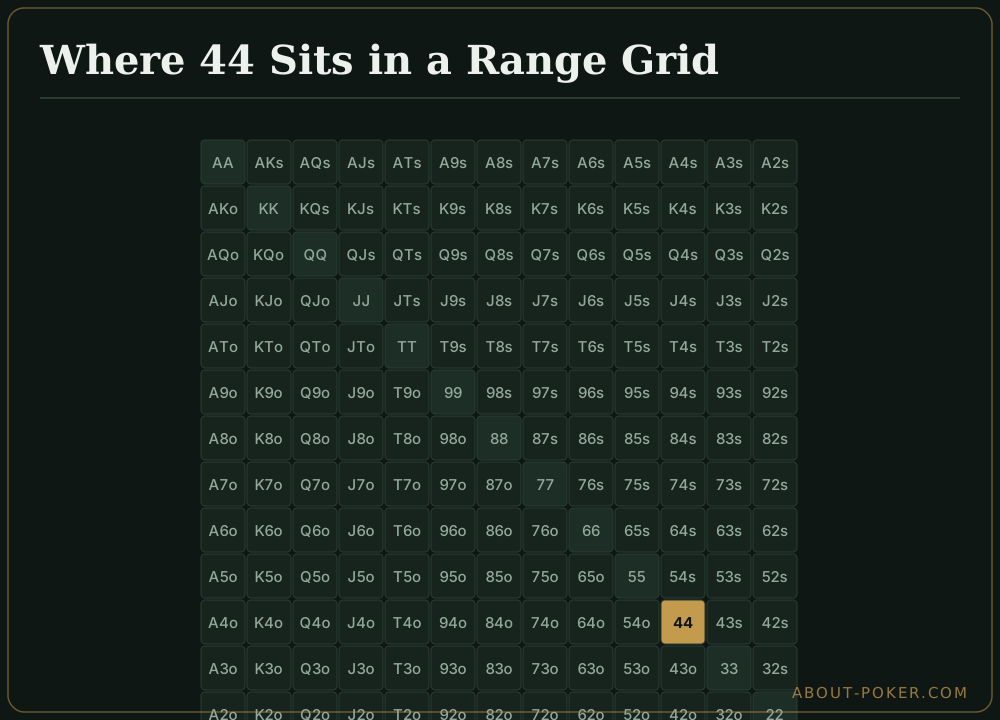
As an open-raise, 44 is standard from middle position through the button in both full-ring and 6-max games. When you raise, you either take the blinds down, get called by worse, or set up a pot where your set potential and the fold equity of a raise both work in your favor. From early position 44 is a closer call — in tougher games with players 3-betting behind you, folding it under the gun is defensible, since you often get squeezed off the hand before you can see a flop.
Pocket fours plays almost identically to its neighbor pocket fives; the tiny rank difference barely matters preflop, because both hands are angling for a set rather than to win with the pair itself. Your preflop opening ranges should include 44 from late position without hesitation.
Set mining and implied odds
When someone opens in front of you, the decision to call with 44 is an implied-odds calculation. You flop a set only about 11.8% of the time — roughly 1 in 8.5 — so you need to win a large pot on the times you hit to pay for all the flops you miss. A common rule of thumb is that you want to be able to win around 15 times the amount you call. Deep stacks and loose opponents who pay off big bets make 44 far more attractive; short stacks and nitty players make it far worse.
This is why 44 belongs in your cold-calling range against single raises when stacks are deep, but usually not against a 3-bet. Facing a re-raise, the effective stack behind is smaller, the price is worse, and you are often out of position — all of which gut the implied odds that justify the call. Against most 3-bets, folding 44 is the clean answer.
A worked example
You call a 3-big-blind open on the button with 4♦4♣, 100 big blinds deep. The flop comes K♠-8♥-4♠ — you have flopped bottom set. This is exactly the payoff you were mining for. When the preflop raiser continuation-bets their strong king, you are miles ahead, and you can raise or call to build a pot with a hand that beats top pair, two pair, and overpairs alike.
Now suppose the flop instead comes A♣-J♦-9♥. You have nothing — an underpair to three overcards. This is the far more common outcome, and it is why the price you paid preflop matters so much: you check-fold to a continuation bet and lose only your small call. Set mining works precisely because the flops you hit are worth many times the flops you fold.
Playing 44 when you miss the flop
Because you miss your set roughly seven times out of eight, most of your profit or loss with 44 comes from how cheaply you fold. When you open 44 and get called, you will often flop an underpair to one or more overcards. In heads-up pots with initiative you can fire a continuation bet on dry, low boards where your underpair still has showdown value and your opponent has missed most of their range — for example a 9-6-2 rainbow flop, where 44 is a decent hand to bet once and give up if raised. In multiway pots, or on high, connected boards, treat your underpair as a check-and-give-up hand rather than forcing the action. The discipline of surrendering these misses cheaply is exactly what makes the rare flopped sets so profitable: you are not throwing away the small edges you paid to see the flop.
The takeaway
Pocket fours is a set-mining hand: open it from late position, call single raises with deep stacks for the implied odds, and fold it to most 3-bets. When you flop a set, get the money in; when you miss, let it go cheaply. Respecting that cheap-flop, big-payoff pattern is the entire art of playing small pairs like 44.
Frequently asked
Should you open pocket fours?
Yes, from most positions. Pocket fours is a standard open from middle position through the button in a full ring or 6-max game. From early position it is closer, and in tough lineups you can fold it under the gun, but as a general rule 44 opens comfortably in late position.
How do you play pocket fours against a raise?
Call to set-mine when the stacks are deep enough — you want roughly 15-to-1 implied odds because you flop a set only about one time in eight. Against a 3-bet you usually fold 44, since you rarely have the implied odds to continue and the pair is too weak to 4-bet or flat profitably out of position.
What are the odds of flopping a set with pocket fours?
About 11.8%, or roughly 1 in 8.5. That is the same for any pocket pair. Because you miss the flop most of the time, the profitability of small pairs like 44 depends heavily on being able to win a big pot on the rare occasions you do hit.