How to Play Six-Five Suited (65s)
65s is a low suited connector that plays for straights, flushes, and equity. Learn when to open, 3-bet, and defend 65 suited, and how to realize its equity postflop.
On this page · 6 sections
Six-five suited (65s) is one of the most enjoyable hands in the deck to play, but it is important to understand why it wins. It rarely wins by making top pair — a pair of sixes or fives is usually second-best. Instead, 65s is a drawing and equity hand: it flops straights, flushes, open-ended straight draws, and flush draws often enough to be profitable, and it does so in disguise. Played from the right positions with the right plan, it’s a small money-maker; played too wide or out of position, it bleeds.
Where 65s belongs preflop
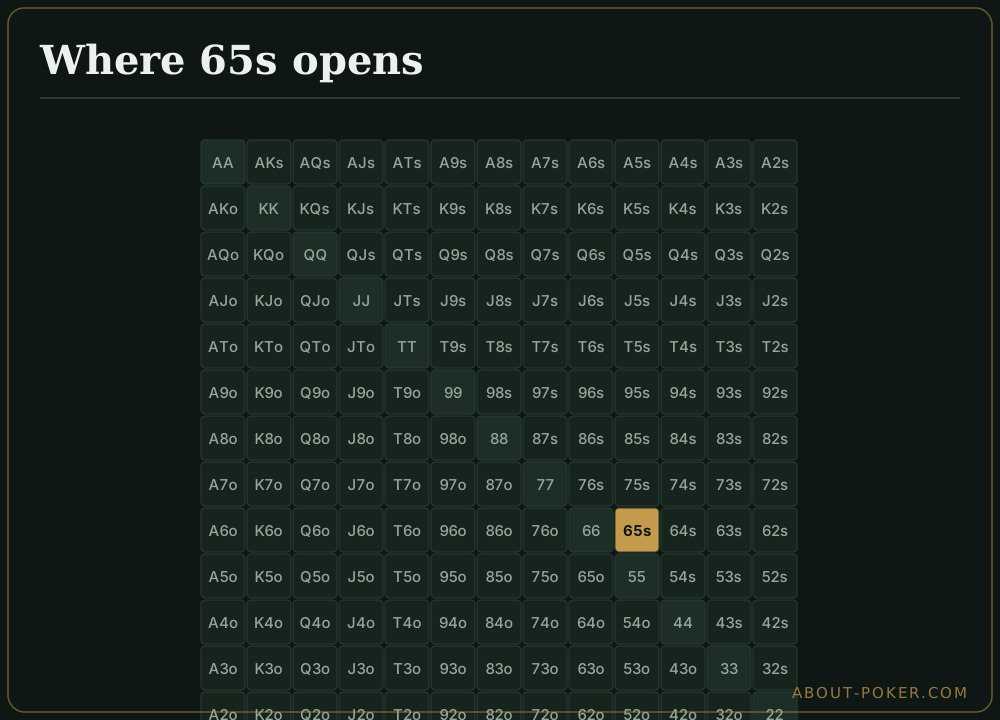
65s is a middle-to-late-position hand:
- Early position: usually a fold at a full table; it needs playability and position it won’t get here.
- Middle position through the button: a standard open. Its connectedness and suitedness give it enough equity to raise first in.
- Small blind: a mix of open-raise and fold when it folds to you.
- Big blind: a strong defend. 65s loves seeing cheap flops from the big blind against a single raise.
For the exact borders by seat, ground yourself in the preflop opening ranges. 65s sits alongside the other low suited connectors like seven-six suited near the speculative edge of your opening ranges.
Why suitedness and connectedness matter
Every property of 65s points toward making big hands, not big pairs. Being suited adds flush potential; being connected with no gap gives it the most straight combinations of any connector class. Together these mean 65s flops a pair-or-better, a flush draw, or a straight draw on a large share of boards. Because those hands are hidden, opponents pay them off when you do hit. That is the trade you’re making: you accept a low-card holding that misses often in exchange for the occasional flop where you have a monster or a monster draw.
65s is also a natural semi-bluff 3-bet. Against a wide late-position open it plays well as a bluff reraise because it has real equity when called and it doesn’t block the folding range. As a bluff it’s a mix — you use it some of the time, not every time — but it’s exactly the kind of hand a balanced 3-betting range wants at the bottom.
Realizing equity postflop
The key skill with 65s is equity realization: turning your draws into showdowns and pots without getting blown off them. In position, that’s easy — you control the pot, take free cards, and barrel your good draws. Out of position it’s harder, which is why 65s wants position or a cheap big-blind flop. When you flop a strong draw, play aggressively; when you flop a weak pair, keep the pot small. Blind-versus-blind, 65s is a frequent attacker and defender because both ranges are wide and its equity runs close; the framework for those battles is in blind vs blind play.
A worked example
You open 6♥5♥ from the button and the big blind calls. The flop comes 7♥ 4♣ 2♥ — an enormous flop for you: an open-ended straight draw (any 3 or 8 makes a straight) plus a flush draw (any heart). That’s roughly 15 outs twice, giving you well over 50% equity against a made top pair. This is a hand you bet and raise aggressively as a semi-bluff, because you have both fold equity and huge drawing equity. Contrast that with a flop like K♠ 9♦ 2♣, where 65s has nothing and should simply give up. The difference between those two flops is the entire game plan for a hand like this.
For a preflop benchmark, 65s has roughly 35-38% equity against a strong pair like QQ all-in — low, but far from dead, and it flips toward a coin flip on the many boards where it flops a big draw. Open 65s from middle and late position, defend it happily in the big blind, mix it in as a 3-bet bluff, and let its draws do the heavy lifting after the flop.
How the plan changes with stack depth
65s is a hand whose value is almost entirely about the future streets, so stack depth matters more for it than for a made hand like a big pair.
- Deep (150bb+): 65s gains value. The whole point of the hand is to occasionally flop a huge disguised hand — a straight, a flush, or a monster draw — and stack an opponent who has an overpair or top pair. Deep stacks maximize that implied-odds payoff, so open a touch wider and defend the big blind more freely.
- Standard (100bb): the baseline described above. Open middle-to-late, defend the big blind, mix in the occasional 3-bet bluff.
- Short (40bb or less): 65s loses most of its appeal. There is no longer enough money behind to reward the times you flop a draw, and the hand cannot make a strong pair to fall back on. Short-stacked, it becomes a fold in most opening spots and a marginal 3-bet-shove candidate only when you specifically need fold equity.
The common thread: 65s is paid off on the river, not the flop, so anything that shrinks the river pot — short stacks, a capped opponent, poor position — quietly kills the hand.
Common mistakes with 65s
- Playing it for pairs. A pair of sixes or fives is almost always second-best. If your plan when you flop a pair is to bet three streets for value, you are misplaying the hand. 65s wants to make straights, flushes, and big draws.
- Calling out of position against a raise. Out of position, 65s realizes far less of its equity because you cannot control the pot or take free cards. Most of its profit disappears when you are first to act on every street.
- Overplaying weak draws. A bare gutshot with no flush backup is not a semi-bluff you should stack off with. Save the aggression for the combo draws — the open-ended-plus-flush-draw flops where you genuinely have more than half the equity.
- 3-betting it every time. As a bluff 3-bet, 65s is a mix. Do it some of the time to stay balanced; jam it into every late-position open and observant opponents will simply flat and outplay you.
Handle those four leaks and 65s becomes exactly what it should be: a cheap, disguised hand that occasionally wins a stack and rarely costs you one. For an even more connected version of the same idea, compare it to seven-six suited, and ground the position-by-position opening bounds in the preflop opening ranges.
Frequently asked
Is 65 suited a good hand?
65s is a fun, playable low suited connector, but it is a drawing hand, not a premium. It opens from middle and late position, defends the big blind well, and profits by flopping straights, flushes, and strong draws rather than by making top pair.
Should I 3-bet with 65 suited?
Yes, occasionally, as a bluff 3-bet. 65s makes a good semi-bluff 3-bet against late-position opens because it has clean equity when called and unblocks the strong hands you want your opponent to fold. It is a mix, not a hand you 3-bet every time.
Can I call a raise with 65 suited?
In position or in the big blind, yes. 65s realizes its equity well when it can see cheap flops and play draws with position. Out of position against an early raise, it is usually a fold because it needs the right price and playability.