What Is Ante in Poker?
An ante is a small forced bet every player posts before the cards are dealt. Here's how antes work, how they differ from blinds, and how they change strategy.
On this page · 6 sections
An ante is a small forced bet that every player at the table posts before the cards are dealt. Unlike the blinds, which only two players pay each hand, an ante is paid by everyone — seeding the pot with extra “dead money” that changes how the whole hand should be played.
Antes are most common in tournaments, where they kick in after the early levels to speed up play and force action. Understanding what an ante does to the math of a hand is one of the most valuable things a new tournament player can learn, because it quietly shifts correct strategy toward more aggression.
How an ante works
Before the cards are dealt, each player contributes the ante — a fixed small amount, typically a fraction of the big blind. Those chips go straight into the pot with no ownership attached to them. Then the small and big blinds are posted as usual, and the hand plays out normally.
The result is a pot that already contains meaningful money before anyone has acted. In a nine-handed game with a big blind of 100 and an ante of 12 per player, the pot starts with 150 from the blinds plus 108 from the nine antes — about 258 chips sitting there before the first decision.
Antes are one of three ways money enters the pot preflop, alongside the blinds and the voluntary straddle. All three are forced or blind contributions that create something worth fighting over.
Ante versus blind
The two are easy to confuse, so keep the distinction clear. The blinds are two rotating forced bets — a small blind and a big blind — paid by the two players to the dealer’s left each hand. The ante is a single small forced bet paid by every player every hand. Blinds are usually much larger than antes, and blinds determine who acts and who has the option to check preflop, while antes simply add dead money to the pot.
The modern shortcut for collecting antes is the big blind ante, where a single player — usually the big blind — posts the entire table’s ante at once. It speeds up dealing and is now standard in most large tournaments.
Why antes change strategy
The key effect of an ante is that it improves the pot odds on every preflop steal and defense. When there is more money in the middle before the action starts, a successful blind steal wins more, and defending your blind is cheaper relative to the pot. Both effects push toward more aggression.
Concretely, antes make you open wider from every position, steal the blinds more often from late position, and defend your big blind with a wider range because the price to call is now better. Passive, fold-heavy play that might survive in a no-ante game bleeds chips fast once antes are in play.
A worked example
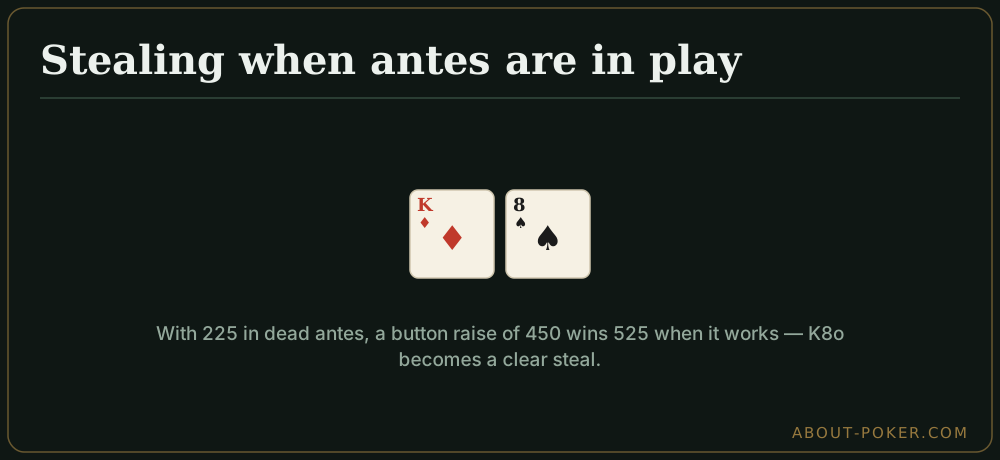
It is a nine-handed tournament, blinds 100/200, with a 25-per-player ante. Before any cards, the pot already holds 300 from the blinds plus 225 from the antes — 525 chips. It folds to you on the button with Kd 8s. Without antes this is a marginal steal, but the 225 in dead antes changes the math. If you raise to 450 and everyone folds, you win 525 — more than your raise. That extra return is exactly why late-position steals become mandatory once antes appear. You raise, both blinds fold, and you pick up a pot larger than the risk you took.
Common mistakes with antes
- Playing too tight. The most expensive error. Antes reward aggression; folding orbit after orbit slowly donates your antes to the stealers.
- Ignoring dead money when defending. With antes in, calling from the big blind is often correct with hands you would fold in a no-ante game, because the pot lays a better price.
- Not adjusting your steal frequency. Late-position raises should go up sharply once antes are in play. If your steal rate is the same as pre-ante, you are leaving chips behind.
- Forgetting antes shrink your stack in blinds. Every orbit costs you blinds plus antes, so your effective stack in big blinds drops faster than it looks.
Quick ante checklist
Each time antes come into play, ask three things: Is there enough dead money that stealing wins me more than I risk? Should I defend my big blind wider because the pot odds improved? And am I opening more hands from every seat to claim my share of the antes? Answer those and you will collect the free money that fold-happy players keep leaving on the table.
Frequently asked
What is an ante in poker?
An ante is a small forced bet that every player at the table posts before the cards are dealt. It seeds the pot with dead money, giving everyone an incentive to fight for it rather than fold and wait for premium hands.
What is the difference between an ante and a blind?
Blinds are posted by only two players each hand, the small and big blind, and rotate around the table. An ante is posted by every player every hand. Blinds are usually larger; antes are typically a small fraction of the big blind.
How does an ante change strategy?
Antes add dead money to the pot, which improves the pot odds on every steal and defense. That means players should open wider, defend their blinds wider, and steal more often, because there is now more to win before the flop.