What Is Board Coverage in Poker?
Board coverage means having strong hands on every type of flop, so no board leaves you weak. Learn why coverage matters and a worked example.
On this page · 6 sections
Board coverage is the idea that your range should contain strong hands across every type of flop, so that no board leaves you helplessly weak. A range with good coverage always has some credible value hands to work with — whether the flop is all high cards, all low cards, or connected and coordinated. A range with poor coverage has holes: textures where you almost never have a strong hand, and good opponents will attack exactly those spots.
What board coverage means
Your preflop range is the set of hands you play from a given position. When the flop arrives, only some of those hands connect. Board coverage asks: across the full universe of possible flops, do I have strong hands on all of them, or only some?
Think of it like defending territory. If your range is all high cards, you crush high boards but have almost nothing on low, connected ones. An opponent who notices can bet relentlessly on low boards because they know you missed. Good coverage means you have planted value hands on every kind of terrain, so there is no board where you simply fold and give up.
Why coverage matters
Coverage is really about being un-exploitable. If certain flops leave your range capped — meaning you can never have the strongest hands — opponents can overbet and bluff those boards freely, and you cannot fight back. Coverage is the antidote. By keeping some hands that connect with low and middling boards, you preserve the ability to have value everywhere, which keeps your bets and calls credible.
Coverage is closely tied to nut advantage: the whole point of holding strong hands on a given board is so you can apply pressure and defend against it. Without coverage, you are constantly ceding boards to the other player.
A worked example
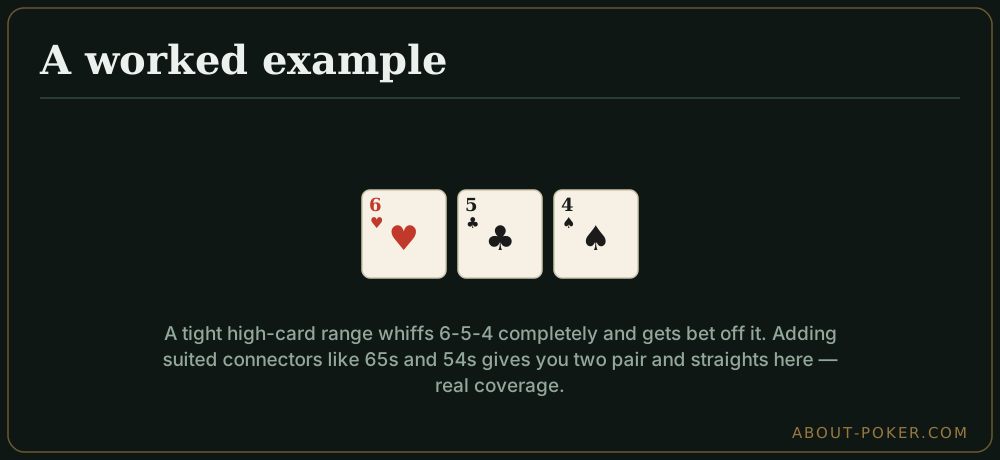
Say you only ever raise A-K, A-Q, and big pairs from early position. On a flop of A♦ K♠ 7♣, you are thrilled — that board is packed with your top pairs and sets. Your coverage there is excellent.
But now the flop comes 6♥ 5♣ 4♠. Your tight high-card range has almost nothing: no sets, no straights, no two pair. You hold A-K high at best. An observant opponent bets every time this kind of board appears, because they know your range whiffed it completely. You are forced to fold far too often, and you cannot bluff-catch credibly because you rarely have a real hand. That hole is a coverage failure.
Now imagine you had also raised a few suited connectors like 6-5s and 5-4s preflop. On that same 6-5-4 board you would flop two pair, straights, and pairs — suddenly you have coverage, and the opponent can no longer bet freely into you.
How to build coverage
The fix is a balanced preflop range that mixes:
- High cards (A-K, A-Q, K-Q) to cover high boards.
- Pairs of every size to make sets on high, middling, and low flops.
- Suited connectors and suited aces to cover low and connected boards with straights, flushes, and two pair.
You do not need many of each — a handful of connectors is enough to keep an opponent honest on low boards. The goal is not to play trash; it is to avoid only playing hands that connect with one narrow slice of the flop universe.
Coverage and your checking range
Coverage also applies within a single street. When you check, that checking range needs some strong hands too — otherwise every check screams weakness, and opponents bet you off the pot. Slow-playing an occasional set or top pair “covers” your checks, so a check does not automatically mean surrender. The same logic runs through the whole hand: any action you take should sometimes contain strength, or it becomes an open invitation to be attacked.
Common mistakes
The biggest mistake is playing a range so tight that it only hits one type of board — usually all high cards — leaving you helpless on low, connected textures. Another is folding all your suited connectors and small pairs to “play only premium hands,” which creates exactly the holes good opponents hunt for. A third is having a checking range made entirely of weak hands, so every check is transparent. Build a range with hands for every board, keep a few surprises in your checks, and you will find far fewer spots where an opponent can run you over.
Frequently asked
What is board coverage in poker?
Board coverage means your range includes strong hands across every type of flop, so you have credible value no matter what cards come. Good coverage keeps you from being weak and easily bluffed on certain textures.
Why is board coverage important?
Because a range that only connects with some boards is exploitable. Opponents can bet aggressively on the boards you miss, knowing you rarely have a strong hand there. Coverage makes your play credible on every texture.
How do I improve my board coverage?
Keep a balanced preflop range with high cards, pairs, and suited connectors so you can flop something strong on high, middling, and low boards alike. Don't fold all your low or connected hands, or you'll have holes.