What Is Board in Poker?
The board is the set of community cards everyone shares. Learn what the board is, how it forms across the flop, turn, and river, and how to read it correctly.
On this page · 6 sections
In community-card games like Texas Hold’em and Omaha, the board is the set of shared, face-up cards in the middle of the table that every player can use. It’s built from the flop, turn, and river, and it grows one stage at a time until five community cards are showing. Learning to read the board — to see instantly what hands it makes possible — is one of the most important skills a poker player develops.
The core meaning: shared community cards
Your two (or four, in Omaha) hole cards are private. The board is public. Everyone at the table combines their own hole cards with the same board to make the best possible five-card hand. Because the board is shared, it’s the great equalizer: the exact same five community cards are available to you and every opponent.
A complete board in Hold’em is five cards. You make your hand by choosing the best five-card combination from your two hole cards plus those five community cards. In Omaha the rule differs — you must use exactly two hole cards and three from the board — but the board itself is still the shared five cards in the middle.
How the board forms: flop, turn, river
The board is dealt in stages, with betting rounds between them. For the full sequence, see our guide to the flop, turn, and river. In brief:
- The flop — the first three community cards, dealt together.
- The turn — the fourth community card, dealt alone.
- The river — the fifth and final community card.
Before each stage, the dealer “burns” a card (discards the top card face down) to guard against cheating. After the river, the board is complete and the hand goes to showdown if two or more players remain.
Reading the board: a worked example
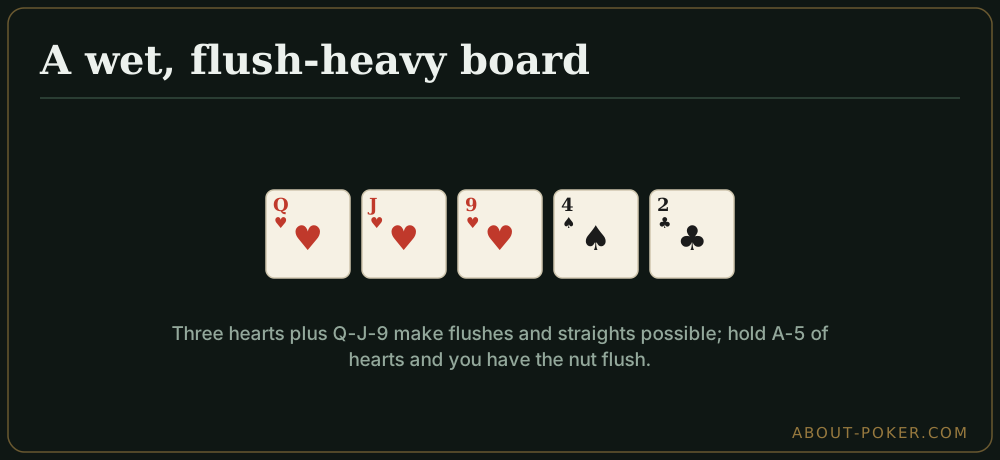
Suppose the final board is Q♥ J♥ 9♥ 4♠ 2♣. What’s possible here?
- Three hearts on the board mean anyone holding two more hearts has a flush — and even a single high heart is dangerous.
- The Q-J-9 create straight possibilities: someone with K-T has a king-high straight; someone with T-8 has a nine-high straight.
- No pair on the board, so no full house or quads are possible for anyone.
Now say you hold A♥ 5♥. You combine your two hearts with the three board hearts to make an ace-high flush — the nut flush, the best possible hand on this board. Because nothing on the board is paired, no one can beat a flush here, so you know your hand is the effective nuts. That kind of instant read comes from studying the board every hand.
Contrast that with a paired board like K♥ K♦ 7♠ 3♣ 2♦, where full houses and quads suddenly become possible and a single pair is far less safe. Board texture changes everything about how strong your hand really is.
Board texture and why it matters
Not all boards are created equal. Players describe boards by their texture — how connected, coordinated, or dangerous they are:
- A rainbow board has three different suits on the flop, so no flush is possible yet. Rainbow, disconnected boards are “dry” and safer for one-pair hands.
- A paired board contains two of the same rank, opening the door to full houses and quads.
- Boards with three cards of one suit, or three cards in sequence, are “wet” — full of flush and straight possibilities that can beat top pair.
Good players constantly ask: what does this board do for my hand, and what could it do for my opponent’s? The answer shapes whether you bet, check, call, or fold.
Common mistakes when reading the board
- Ignoring flush and straight threats. New players fixate on their own pair and forget the board might make an opponent’s flush or straight.
- Overvaluing top pair on a wet board. Top pair is much weaker on Q♥ J♥ 9♥ than on K♦ 7♠ 2♣. Adjust to the texture.
- Missing that the board plays itself. Sometimes the five community cards are the best hand (for example, a royal flush on the board), and everyone still in chops the pot. Always check whether your hole cards actually improve on the board.
- Forgetting Omaha’s two-card rule. In Omaha you can’t “play the board” the same way; you must use exactly two hole cards.
Quick reference checklist
- The board is the shared community cards in the middle.
- A complete Hold’em board has five cards (flop, turn, river).
- Everyone uses the same board with their own hole cards.
- Judge board texture — dry vs. wet — to gauge danger.
- Always read the board for flush, straight, and full-house threats before acting.
Master the board and you master poker’s shared information. Every decision you make flows from an accurate read of those five cards in the middle.
Frequently asked
What is the board in poker?
The board is the set of face-up community cards shared by all players in games like Texas Hold'em and Omaha. It consists of the flop, turn, and river — five cards in total once the hand is complete.
How many cards are on the board in Texas Hold'em?
A complete board in Hold'em has five community cards: three on the flop, one on the turn, and one on the river. Every player combines these with their hole cards to make the best five-card hand.
What does 'reading the board' mean?
Reading the board means assessing what hands the community cards make possible — flushes, straights, full houses — and how likely opponents are to have connected with them. It's a core skill for judging the strength of your own hand.