What Is Cap in Poker?
Cap in poker has three meanings: a limit on betting per street, a max buy-in game format, and a capped range. Here's how each one works with examples.
On this page · 7 sections
Cap is one of those poker words that means different things in different contexts, and mixing them up can cost you money. Depending on the table, “cap” can describe a limit on betting during a hand, a specific game format with a maximum wager, or the strategic idea of a range that contains no premium hands. Understanding all three keeps you from being confused at the table and helps you exploit opponents whose ranges are capped.
Cap as a Betting Limit
The oldest meaning of cap comes from limit poker. In fixed-limit games, the number of raises on each street is capped, usually at four total (a bet plus three raises) when the pot is heads-up. Once the fourth bet goes in, players say the betting is “capped” and no one can raise again; the action is just call or fold. This prevents endless re-raising wars in games where bet sizes are fixed and small.
If a dealer announces “the betting is capped,” it simply means the maximum number of raises for that round has been reached. You will hear this most in limit hold’em and stud, rarely in no-limit.
Cap as a Game Format
In no-limit and pot-limit cash games, a “cap game” puts a ceiling on how much money you can wager in a single hand, usually stated in big blinds (for example, a 40 big blind cap). You can bet and raise normally until your total investment for the hand hits the cap; after that, all remaining betting stops and the hand is checked down to showdown or resolved with whatever is already in the pot.
Cap games appeal to players who want no-limit-style action but with limited downside variance. Because you can never lose more than the cap in one hand, the format plays a bit like a series of short-stacked confrontations. Your stack-to-pot ratio, or SPR, effectively shrinks once you approach the cap, which shifts a lot of decision-making toward the earlier streets. This is closely related to how your effective stack governs every no-limit decision.
Cap as a Capped Range
The most strategically important meaning is the “capped range.” A range is capped when the way a player has bet or called rules out the strongest hands. If a player just flat-calls a raise preflop rather than 3-betting, they almost never have AA, KK, or AK, because those hands re-raise. Their range is therefore capped at pocket pairs and suited broadways, and it hates facing large bets.
Spotting a capped range is one of the biggest edges in no-limit. When you know your opponent cannot have the nuts, you can bet big or bluff aggressively, confident they must fold their medium-strength holdings.
A Worked Example
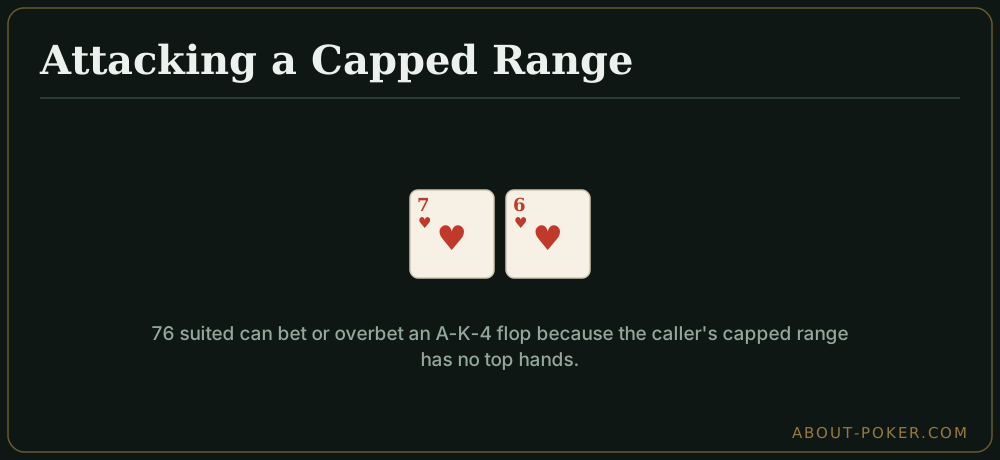
You raise the button with 76 suited and the big blind calls. The flop comes A-K-4 rainbow. Your opponent checks. On this board, the big blind’s calling range is heavily capped: they would usually 3-bet AK, AA, and KK before the flop, so they rarely have the top of the range now. They mostly have weak aces, king-x, and floats.
Because their range is capped, you can bet small to fold out air, or even overbet to attack the many one-pair hands that cannot stand heat. Your actual holding barely matters; you are betting because their range, not your cards, tells you they are weak.
How Cap Games Change Strategy
In a cap game, plan the whole hand around the ceiling. If the cap is 40 big blinds and you get 15 big blinds in preflop with a strong hand, you are nearly committed and should be willing to get the rest in. Speculative hands lose value because you cannot win a huge pot when you hit; there is a cap on the payoff. Tighten your calling ranges and lean toward hands that make strong top pair or better.
Common Mistakes
Players new to the term confuse the three meanings. Do not assume “capped” always signals weakness; in a limit game it just means no more raises are allowed. Conversely, in no-limit, ignore capped ranges at your peril: failing to attack a capped opponent leaves easy money on the table. For a broader plain-language overview, see our companion piece on what cap means in poker.
Quick Checklist
- Limit game and the dealer says capped? No more raises this street.
- Playing a cap game? Plan around the per-hand ceiling and favor strong made hands.
- Facing a preflop flat-caller or a passive line? Suspect a capped range and apply pressure.
Keep the three senses of cap straight and you will read the table faster and exploit weakness more consistently.
Frequently asked
What does cap mean in poker?
Cap has three common meanings. It can be a limit on how many raises or how much money can go in on a betting round, a game format with a maximum amount you can wager per hand, or a description of a player's range that contains no very strong hands (a capped range).
What is a cap game in poker?
A cap game is a no-limit or pot-limit table with a ceiling on how much each player can put in during a single hand, often expressed in big blinds. Once you hit the cap, betting stops and remaining action is checked to showdown.
What does it mean to have a capped range?
A capped range means your line has excluded the strongest possible hands. For example, a player who only calls preflop instead of 3-betting usually has no aces or kings, so their range is capped at medium strength and is vulnerable to big bets.