What Is SPR in Poker?
SPR — stack-to-pot ratio — divides the effective stack by the pot to tell you how committed you are. Learn low vs high SPR and how it guides commitment.
On this page · 8 sections
SPR, or stack-to-pot ratio, is the effective stack divided by the size of the pot at the start of a betting round — usually measured on the flop. It is one of the most useful planning numbers in No-Limit Hold’em because it tells you, at a glance, how committed you are and which hands are worth playing for stacks. A low SPR makes strong-ish hands easy to commit with; a high SPR demands genuine monsters before you pile the chips in.
The Formula
SPR = effective stack ÷ pot
The effective stack is the smaller of the two remaining stacks, since that is all that can change hands. The pot is whatever sits in the middle when the flop is dealt. SPR is set the moment the flop appears — the preflop action determines it, which is why bet sizing before the flop quietly decides how the rest of the hand plays.
A Worked Example
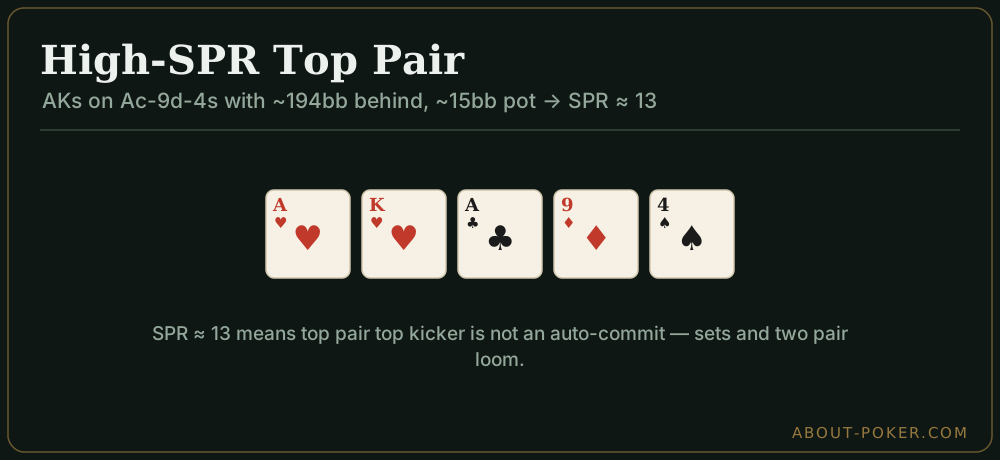
Blinds are 1/2. You raise to 6 with Ah-Kh, one player calls, and the pot is now roughly 15 (with the blinds). You started the hand with 200 and so did your opponent, so after the raise-call each of you has about 194 behind. On the flop the effective stack is ~194 and the pot is ~15, so your SPR is about 13 — very high. If the flop comes Ac-9d-4s, you have top pair top kicker, but with an SPR of 13 you should be cautious about stacking off, because your opponent needs only a set or two pair to have you crushed and there is a mountain of chips to lose.
Now rewind: suppose instead there was a 3-bet and 4-bet preflop, building a pot of 60 with only 90 behind each. Your SPR is now 1.5 — very low. On that same Ac-9d-4s flop, top pair is an easy commit. There simply is not enough money left to fold a strong made hand, and any continuation bet essentially locks you in.
Low SPR: Commit With Made Hands
When SPR sits around 3 or below, the pot is large relative to the stacks. Top pair, overpairs, and strong draws happily get all-in because the risk-to-reward favors committing and there is no room to be outplayed on later streets. This is the world of 3-bet and 4-bet pots. The lesson: if you build a big preflop pot, plan to go with a fairly wide range of decent hands, because you have made yourself pot-committed with the SPR you chose.
High SPR: Demand Real Strength
When SPR climbs to 7 or higher, deep stacks loom behind a small pot. One-pair hands become dangerous to stack off with because there are three streets of large bets available and your opponent needs only a modest upgrade to trap you. In high-SPR pots you want to play more carefully, pot-control your medium hands, and reserve stacking off for two pair, sets, straights, and flushes. Bluffs and semi-bluffs also gain power because there is enough depth to apply real pressure over multiple streets.
Medium SPR: The Tricky Middle
An SPR around 4 to 6 is the hardest to navigate. Top pair is neither an automatic commit nor an easy fold, and skilled players earn most of their edge here through good reads and disciplined sizing. When in doubt in this zone, control the pot with your marginal hands and save aggression for your strongest holdings and best bluffs.
How to Use SPR Before the Flop
Because SPR is fixed by preflop action, you can engineer it. Holding a hand that plays best all-in, like a big pair, you can 3-bet to shrink the SPR and remove awkward postflop decisions. Holding a hand that wants to see cheap flops and maneuver, like suited connectors, you prefer a high SPR and just call. Thinking one step ahead about the SPR you are creating is a hallmark of strong players.
Common Mistakes
- Stacking off top pair at high SPR. The most common leak — folding is fine when 100-plus big blinds sit behind.
- Folding strong hands at low SPR. Once committed, releasing top pair in a tiny-SPR pot burns money.
- Ignoring SPR preflop. Your raise size and whether you 3-bet decide the SPR you will live with.
- Treating all SPRs the same. The identical flop plays completely differently at SPR 1.5 versus SPR 13.
Quick Checklist
On the flop, divide the smaller stack by the pot. Low SPR? Commit with your good made hands. High SPR? Slow down and demand real strength. Medium? Control the pot and pick your spots. Then remember that your next preflop decision is quietly setting the SPR for the whole hand.
Frequently asked
What is SPR in poker?
SPR stands for stack-to-pot ratio. It is the effective stack divided by the size of the pot at the start of a betting round, and it tells you how much money is left to play relative to what is already in the middle.
How do you calculate SPR?
Divide the effective stack — the smaller of the two remaining stacks — by the current pot. If the pot is 20 and the smaller stack is 80, the SPR is 80 ÷ 20 = 4. It is normally measured on the flop.
What is a low SPR?
A low SPR, roughly 3 or below, means the stacks are small compared to the pot. Top pair and overpairs become easy commits because there is little room to maneuver and folding a strong made hand would be a mistake.
What is a high SPR?
A high SPR, roughly 7 or more, means deep stacks relative to the pot. Marginal made hands lose value and you need stronger holdings — two pair, sets, and better — to justify committing all the chips.