What Is Dangler in Poker?
A dangler is a card in your Omaha hand that does not connect with the others, effectively wasting one of your four cards. Learn to spot and value danglers.
On this page · 6 sections
A dangler is a card in your Pot-Limit Omaha (PLO) hand that just does not fit. It shares no useful connection, in rank or in suit, with your other three cards, so it “dangles” off the side of an otherwise coordinated holding. Recognizing danglers is a core skill in Omaha because it tells you the truth about how strong your four cards really are. A hand that looks like four working cards but actually has a dangler is closer to a three-card hand, and three-card hands play far weaker than they appear.
What makes a card a dangler
In Omaha you must use exactly two of your four cards. The strength of a hand comes from how many good two-card combinations it produces. A dangler barely participates in any of those combinations. Consider Ac Kc Qd 3h. The A-K-Q core is excellent: nut flush potential in clubs, Broadway straight combos, top pairs. But the 3h connects with nothing. It is not suited with the clubs, it is not near the K-Q-A in rank, and it makes only very weak straights. That 3h is a textbook dangler.
The practical effect is that you are really playing A-K-Q, three cards, in a game designed around four. You have given up roughly a quarter of your hand’s potential.
Why danglers cost you money
Every card that does not connect reduces the number of ways you flop something useful, whether that is a combo draw, a two-pair-plus-draw, or a wrap. A fully connected, double-suited hand pulls six live two-card combinations and multiple flush possibilities. Add a dangler and several of those combinations turn to dust.
Danglers also encourage a specific and expensive mistake: overvaluing the hand preflop because three of the four cards look pretty. Players see A-K-Q and raise or call as if they hold a premium, forgetting the fourth card contributes almost nothing. This is how strong-looking hands become chronic losers.
When a dangler is tolerable
A dangler is not automatically a fold. Two things can rescue a hand:
- A very strong three-card core. If your other three cards form a high, double-connected, suited group, the hand can still be playable in position even with a dangler. For example, Js Ts 9d 2c has a strong JT9 core, and the 2 is only a minor drag.
- A useful blocker. Occasionally the “dangler” holds a key blocker, an ace that blocks the nut flush or nut straight, that has some value in specific spots. This is a small effect and rarely changes a marginal decision.
Everything else pushes toward folding. A weak core plus a dangler, like 9d 7s 4c 2h, is simply four bad cards pretending to be a hand.
A worked example
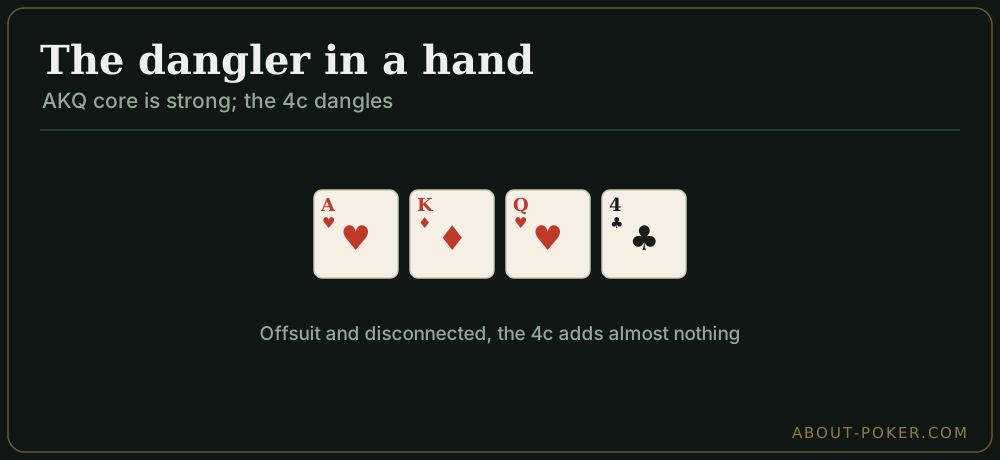
You are dealt Ah Kd Qh 4c on the button and face a single raise. It is tempting to call: you have two suited high cards and Broadway potential. But notice the 4c is a dangler, it is offsuit and disconnected. Your real hand is A-K-Q with a heart flush draw, a solid but not premium three-card holding.
The flop comes Th 6h 2s. You have flopped the nut flush draw plus a gutshot to Broadway with any jack. That is a fine combo draw, and you can continue, but the 4c did nothing to help. Now imagine the same three good cards but a 4h instead of 4c. Suddenly you are double suited and the hand is meaningfully stronger. The dangler was quietly costing you equity the whole time.
Common mistakes with danglers
- Counting four cards when you have three. Always ask which card is doing nothing before you commit chips. If one card dangles, discount the hand.
- Confusing a dangler with a dominated hand. Domination is about how your hand stacks up against an opponent’s range; a dangler is about internal coordination within your own four cards. Both hurt equity, for different reasons.
- Chasing pretty pictures. A-K-x-x and K-Q-J-x look great to Hold’em eyes. In Omaha the offsuit x is often a dangler, and the hand is far more ordinary than it looks.
Quick checklist
Before playing an Omaha hand, name the dangler if there is one. Then ask: Is my three-card core high, connected, and suited? Am I in position? If the core is strong and you have position, a single dangler is survivable. If the core is weak or you are out of position, let the hand go. Spotting danglers is one of the simplest habits that separates disciplined Omaha players from the crowd donating chips with four-card mirages.
Frequently asked
What is a dangler in poker?
A dangler is a card in a four-card Omaha hand that does not connect in rank or suit with your other three cards. It contributes little, so a hand with a dangler effectively plays like a three-card hand. AKQ2 with the 2 offsuit has a dangler.
Are danglers always bad?
Not always, but they lower a hand's value. A dangler can occasionally add a marginal blocker or a low-card straight combo, but most of the time it is dead weight. Hands built around three coordinated cards plus a dangler are weaker than fully connected hands.
Should I fold Omaha hands with a dangler?
Often yes, especially from early position or out of position. A strong three-card core, like a suited high rundown, can still be playable with a dangler, but you should discount the hand and avoid overcommitting. Weak, disconnected cores plus a dangler are clear folds.