What Is Dead Blind in Poker?
A dead blind is a forced bet that does not count toward your wager. Learn when you pay one, how it differs from a live blind, and how to avoid it.
On this page · 6 sections
A dead blind is a forced bet you place into the pot that does not count toward any live wager. The chips are pushed into the middle as pure “dead money,” and unlike a normal big blind you never get to use them to call or check. Understanding when a dead blind appears — and how to sidestep paying one you don’t owe — is part of being comfortable in any live cash game.
The core answer: dead money, no rights attached
When you post a live blind, you have rights. If you post the big blind and everyone limps, the action comes back to you and you can check for free because your blind already covers the bet. A dead blind gives you none of that. It sits in the pot regardless of what you do next, and if you want to see the flop you still have to put in a full live bet on top.
Think of it as a penalty or a placeholder. The dealer collects it, drops it straight into the pot, and moves on. You have effectively paid to keep your seat “in order” without buying any live betting rights with those chips.
The most common situation: re-entering after missed blinds
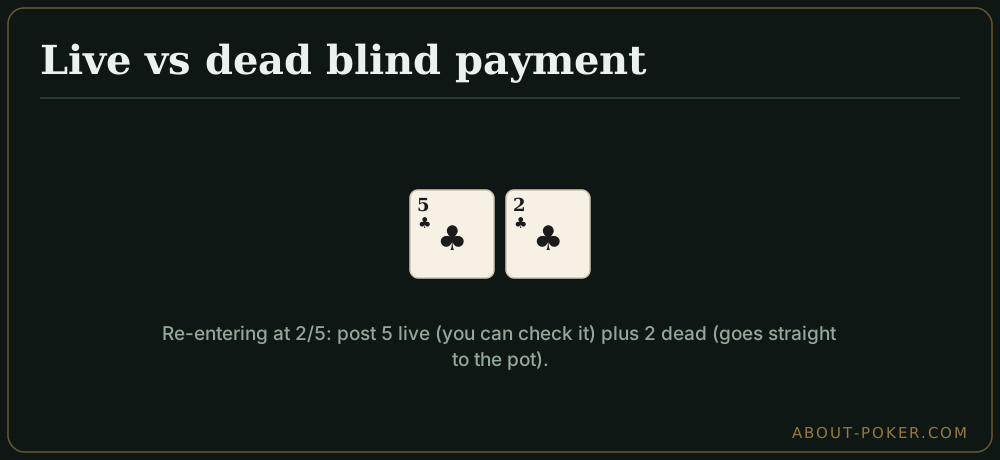
The classic dead-blind moment happens in a cash game. Say you get up to take a phone call and miss your big blind and small blind. When you return, the rules don’t let you simply wait for the button to reach you again for free — that would let players dodge the blinds by timing their absences.
Instead, most rooms require you to either wait for the big blind to reach you naturally, or post to re-enter immediately. If you choose to post immediately, you typically pay:
- One amount equal to the big blind, which is live — you can check or raise with it.
- One amount equal to the small blind, which is dead — it goes straight to the pot.
So if blinds are 2/5, you post 5 live and 2 dead, for a total of 7. Only the 5 gives you betting rights. This is closely related to the live blind, which is the half of that payment that actually counts.
A worked example
Blinds are 1/2. You miss both blinds while stepping away, then sit back down in early position. You choose to post rather than wait.
- You place 2 chips live (the big-blind portion).
- You place 1 chip dead (the small-blind portion), pushed into the pot.
- The dealer deals you a hand.
Preflop, three players limp for 2. The action reaches you. Because your live 2 already matches the limps, you can check and see the flop for free with your live portion — but the 1 dead chip is gone into the pot no matter what. If instead you’d been paying only a dead blind (no live portion, as sometimes happens after certain button movements), you would have to put in a fresh 2 to call, even though you already had a chip in the middle.
That single dead chip is the whole point of the term: it is money in the pot that buys you nothing on this street.
Dead blinds and the moving button
Dead blinds also appear when the button, small blind, and big blind can’t all sit on players who owe them — for instance when a player between the blinds busts or leaves. Rather than let someone skip the small blind entirely, some rooms place a dead small blind in that spot. The button still moves forward, and a small blind is “posted” to no one’s benefit. This is a cousin of the dead button rule, which handles the same fairness problem from the button’s side.
The underlying principle is consistency: over a full orbit, every player should pay the same blinds. Dead blinds are the accounting tool that keeps that true when seats shift.
Common mistakes players make
- Posting when you don’t have to. If you’re patient, you can almost always wait for the big blind to reach you for free instead of paying a dead blind to enter early. New players often post out of habit and give up small blinds for no reason.
- Treating the dead chip as callable. Beginners sometimes think their dead blind counts toward a call. It doesn’t. Listen to the dealer’s count.
- Confusing it with a straddle. A straddle is a voluntary live raise posted in the dark; a dead blind is a mandatory, non-live payment. They are opposites in almost every way.
- Forgetting position. After posting to re-enter, you’re often in an awkward early spot with a hand you didn’t choose to play. Don’t feel obligated to continue just because you have chips invested.
Quick checklist before you post
- Ask the dealer if you can simply wait for the big blind instead.
- If posting, confirm the live vs dead split (usually big blind live, small blind dead).
- Remember the dead portion never counts toward calling or raising.
- Don’t overvalue a random hand just because you paid to enter.
- When in doubt, wait — patience saves chips over a session.
Dead blinds feel confusing the first few times, but the rule is simple: it’s forced money with no strings attached to it. Know when you owe one, know that it buys you nothing live, and you’ll navigate the blinds smoothly at any table.
Frequently asked
What is a dead blind in poker?
A dead blind is a forced amount you put into the pot that does not count as part of a live bet. The chips are pulled into the middle immediately and you do not get to see a raise 'come back' to you the way you would with a live big blind.
When do you have to post a dead blind?
You post a dead blind most often when you re-enter a cash game after missing your blinds, or when the button and blinds move in a way that would otherwise skip a position. The dealer will tell you the amount, usually equal to the small blind.
Is a dead blind the same as a live blind?
No. A live blind counts toward your wager, so if no one raises you can check the big blind. A dead blind is dead money in the pot and never counts toward calling or raising.