What Is Counterfeit in Poker?
In poker, a counterfeit happens when a board card weakens your hand by matching what you already hold. Learn how counterfeiting kills two pair and low hands.
On this page · 8 sections
Counterfeiting is one of those quiet disasters that turns a winning hand into a loser without you doing anything wrong. Understanding it helps you dodge big mistakes on later streets and read dangerous boards before they cost you a stack.
The Core Answer
A counterfeit happens when a community card duplicates a card you already hold or pairs the board in a way that erases the value of your hand. Your two hole cards do not change, but the strength of your five-card hand drops because the board now offers everyone a hand as good as, or better than, yours. The classic case is two pair getting flattened into an effectively weaker holding when the board pairs.
The term comes from the idea that the card looks like it helps but is actually fake value — a counterfeit. It shows up most in Hold’em two-pair spots and in split-pot games where low hands matter.
A Worked Example
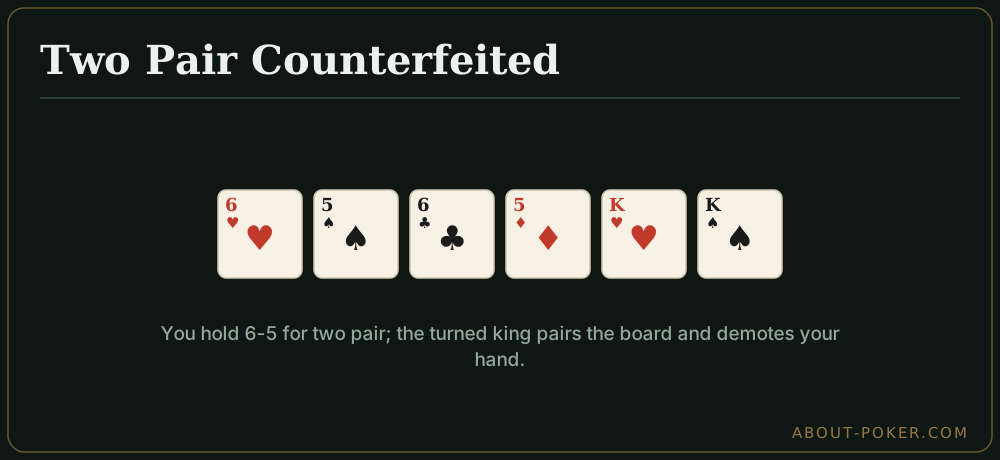
You hold 6-5 and the flop comes 6-5-K. You have two pair, sixes and fives, which is a strong-looking hand. The turn is a king, making the board 6-5-K-K. Now the board itself contains a pair of kings. Your best five cards are kings and sixes with a five kicker. But your opponent holding A-6 also plays kings and sixes — and their ace kicker beats your five. Worse, anyone with a king now has trips. Your two pair got counterfeited: the same cards that felt strong on the flop are now barely holding on.
Counterfeiting in Low and Split-Pot Games
In games like Omaha Hi-Lo, counterfeiting is even more common because the low hand depends on your specific small cards. Suppose you hold A-2 for a strong low draw and the board already shows a 2. Your deuce is now duplicated by the board, so it no longer improves your low; you effectively play only your ace for low purposes. A card that seemed to lock up half the pot suddenly does nothing, which is the essence of a counterfeit.
Why It Feels Like a Cooler
Getting counterfeited often feels like a cooler because you flopped a genuinely good hand and lost through no misplay. The difference is that a true cooler is unavoidable, while counterfeiting can sometimes be sidestepped by betting hard early to deny your opponent the chance to catch up, or by controlling the pot when your hand is fragile. Recognizing that bottom two pair is vulnerable is the first step to not paying it off.
How to Play Around It
The main defense is to know which hands are fragile. Bottom and middle two pair, small sets on coordinated boards, and low hands in split games all risk counterfeiting. With these holdings, favor betting and raising on the flop rather than slow-playing, so opponents fold or pay before a bad card arrives. When the board pairs on the turn or river, re-evaluate honestly: your two pair may no longer be near the nuts, and calling a big bet could mean paying off a full house.
Common Mistakes
The biggest error is treating two pair as a monster on every street. Players fall in love with the flop and refuse to slow down when the board pairs, then lose a stack to trips or a bigger two pair. Another mistake is not counting the board carefully at showdown, so you misjudge whether your kicker still plays. A third is over-committing in Hi-Lo with a low that a single duplicate card can wreck.
Reading the Board for Counterfeit Danger
Certain board textures scream counterfeit risk, and learning to spot them early saves stacks. Paired boards are the obvious one: any board that already shows a pair means a card matching your holding could promote an opponent to a full house while doing nothing for you. Boards where your two pair uses two of the lowest cards are especially fragile, because so many higher cards can pair and out-rank you. Connected, high-card boards are safer for your two pair because there is less room above you. When you flop bottom two pair on a board like K-6-5 and you hold 6-5, treat every high card on the turn as a potential counterfeit and size your bets to charge draws and take the pot down before that card can land.
Quick Checklist
When you hold a vulnerable made hand, ask yourself three questions. If the board pairs, does my hand still beat my opponent’s likely range? Am I better off betting now to charge draws and avoid a bad runout? And at showdown, have I counted all five cards to see whether a counterfeit quietly demoted me? Answering these keeps you from paying off the hands that counterfeiting builds.
Frequently asked
What does counterfeit mean in poker?
A counterfeit occurs when a community card duplicates part of your hand and reduces its value, usually by turning your two pair into a weaker holding or by pairing the board so a lower card no longer helps you.
How does two pair get counterfeited?
If you hold a low two pair and the board pairs a higher card, the top two pair on the board can outrank yours, and your smaller cards may become useless kickers. Your hand looks the same but is now much weaker.
Can you avoid getting counterfeited?
You cannot prevent the cards that fall, but you can play cautiously with vulnerable hands like bottom two pair, slow down when the board pairs, and avoid over-committing chips before scary cards arrive.