What Is Limp Behind in Poker?
Limping behind means calling the big blind after someone has already limped. Learn what limp behind means, when it works, and when a raise is better.
On this page · 6 sections
To limp behind is to call the big blind after another player has already limped into the pot. You are not the one who opened the action for the minimum — a player ahead of you did that — and rather than raising over them, you simply match the big blind and step into the limped pot behind the earlier limper.
The name is descriptive: you limp (enter for the price of the big blind) behind someone who already limped. If you have read about the overlimp, you already know this play — limp behind and overlimp are two names for the exact same action.
Limp Behind vs. Open Limp vs. Raise
Three preflop entries get confused, so keep them distinct:
- An open limp is being the first to just call the big blind in an unopened pot.
- A limp behind is calling the big blind after someone has already limped, joining a pot that is already multiway.
- A raise or iso-raise commits more chips, takes the betting lead, and can fold out limpers or set up a heads-up pot.
The choice comes down to a trade-off. Limping behind keeps the pot small and the field wide, buying you a cheap flop with a speculative hand. Raising costs more but grabs initiative and thins the field. A pure limp habit only works if you limp for real reasons — and “a cheap multiway flop” is one of them.
When Limping Behind Makes Sense
Limping behind shines with hands that want cheap flops and many opponents:
- Small and medium pairs (22–99) chasing sets.
- Suited connectors and one-gappers (76s, T8s) that make straights and flushes.
- Suited aces that flop the nut flush draw.
These holdings pay off when several players see the flop and you stack someone the times you connect. It is also more reasonable in loose, passive games where a raise gets three callers anyway — so raising just inflates a pot you will play out of position with a marginal hand.
A Worked Example
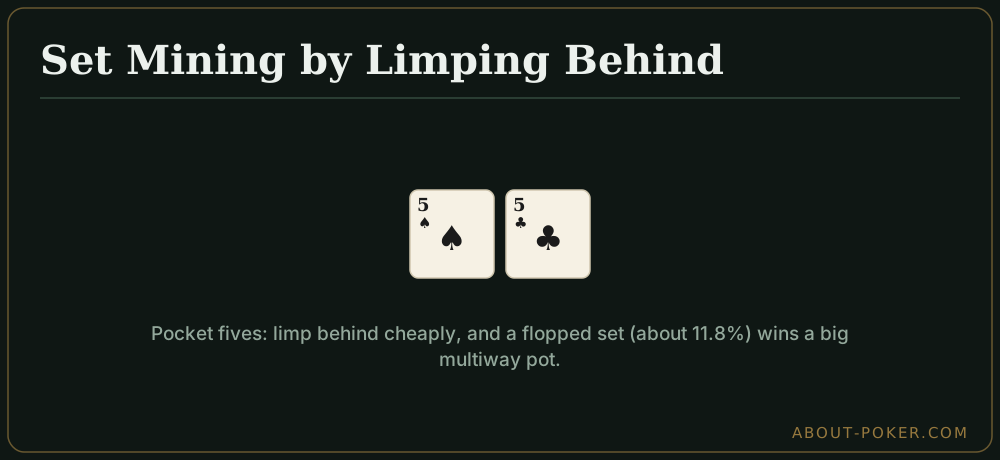
You are in the cutoff of a $1/$2 game holding 5♠5♣. One player limps for $2 under the gun. You could raise to $12 to isolate, but the whole table is loose and you expect two or three callers, leaving you with a bloated pot and a hand that is usually a bluff-catcher after the flop unless you spike a set.
So you limp behind for $2. Two more players and both blinds come along, and six players see a flop for a total pot of about $12. The flop is 5♦J♥8♣ — you have flopped a set. Because the pot is small and multiway, when the money goes in you are getting paid by top pair, draws, and overpairs alike. Your set of fives is roughly a 90% favorite against a single overpair, and here you likely get action from several hands. That is the big pot that cheap limps behind are meant to win: hitting a set is about a 1-in-8.5 chance on the flop (roughly 11.8%), so you need the times you hit to be well paid.
Common Mistakes
- Limping behind premium hands. Calling behind with AA, KK, or AK squanders value and lets the blinds in cheaply. Raise these to build the pot while you are ahead.
- Limping behind weak offsuit junk. K8o and Q9o flop weak pairs that lose big multiway pots. If a hand does not flop well and is not worth raising, fold it.
- Limping behind out of position. Acting first after the flop with little information is a losing recipe for a speculative call.
- Forgetting the isolation raise. One weak limper plus tight blinds is a signal to raise and play heads-up against a bad player, not to join the limp parade.
How Position and Opponents Change It
Position is the biggest lever. On the button or in the cutoff, limping behind lets you act last after the flop and, on the button, closes the action so no one can raise you. From early position it invites raises from everyone left to act and traps you playing a bloated pot out of position. The later you are, the better limping behind gets.
Opponents matter too. Against fishy, passive limpers, an iso-raise that punishes their weak ranges usually beats limping behind. Against aggressive players who love to squeeze on limpers, limping behind is risky — you will often face a raise and give up your call.
Quick Checklist Before You Limp Behind
- Does my hand flop well multiway (pairs, suited connectors, suited aces)? If yes, limping behind is defensible.
- Would a raise fold the field or isolate a weak player? If yes, raise instead.
- Am I in late position to realize equity and maybe close the action? Limping behind gains value.
- Could I get raised behind me? Be prepared to fold your cheap call.
Limping behind is a small, low-cost tool for seeing flops with the right hands. Play it with a plan — the correct hands, good position, and passive opponents — and it earns its place. Do it lazily with any two cards and it is just a leak.
Frequently asked
What does limp behind mean in poker?
Limping behind means calling the big blind after one or more players have already limped into the pot. You are not opening the action for the minimum — someone did that ahead of you — you are joining an existing limped pot by matching the big blind. It is essentially the same play as an overlimp.
Is limping behind the same as an overlimp?
Yes, the two terms describe the same action: calling the big blind after another player has limped. Limp behind emphasizes that you act after the limper, while overlimp emphasizes that you limp on top of an existing limp. In practice players use them interchangeably.
When should you limp behind?
Limping behind is best with hands that flop well in multiway pots, such as small pocket pairs and suited connectors, when raising is unlikely to fold the field or win outright. Against weak limpers, isolating with a raise usually earns more than limping behind.