What Is Overcard in Poker?
An overcard is a card higher than the board or higher than your opponent's pair. What two overcards are worth, the odds, and how to play them.
On this page · 6 sections
An overcard is a card ranked higher than the cards on the board, or higher than your opponent’s pair. If the flop is 8-5-2 and you hold A-K, both your cards are overcards — neither has paired, but each is bigger than anything on the table. Overcards represent unmade potential: you have not connected yet, but you hold cards that beat the board if they pair up. Learning what they are worth is one of the most useful skills for a new player, because so many hands arrive on the flop as “just overcards.”
Two meanings of the word
The term gets used two ways, and both are standard. First, an overcard can mean a card in your hand higher than the board — A-K on a 9-high flop holds two overcards. Second, an overcard can mean a board card higher than your pair. If you hold pocket tens and the flop brings a king, that king is an overcard to your pair, and it is a warning sign that someone may now have you beat.
Both meanings point at the same underlying idea: rank matters, and a higher card looms over a lower one. Do not confuse an overcard with an overpair, which is a pocket pair bigger than the whole board, or with an underpair, a pocket pair smaller than a board card.
What two overcards are worth
The most common overcard situation is holding two big cards like A-K, A-Q, or K-Q on a low, uncoordinated flop. You have six outs to make top pair — three cards to pair your first overcard and three to pair your second.
Six outs is meaningful. Using the rule of 2 and 4, six outs is about 12 to 13 percent to hit on the next card and roughly 24 percent to hit by the river. That is why A-K against a hand like pocket sevens is close to a coin flip rather than a hopeless underdog: the pair is ahead now, but the overcards have enough outs, plus sometimes a straight or flush chance, to catch up about 45 to 50 percent of the time over five community cards.
A worked example
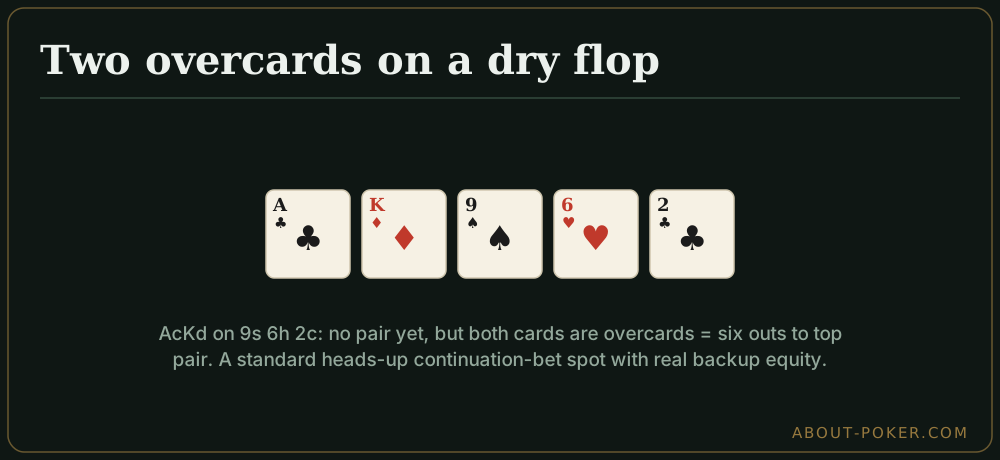
You raise with A♣ K♦ and get one caller. The flop is 9♠ 6♥ 2♣. You have missed — but you hold two overcards, six clean outs to top pair, and the initiative because you raised before the flop.
This is a standard continuation-bet spot. Most hands your opponent called with also missed this flop, so a bet often wins right away. When you get called, you still have those six outs to pair the ace or king and make the best hand. If an ace or king lands on the turn, you now have top pair with the best kicker and can bet for value. If the turn bricks, you can decide whether a second bullet makes sense based on your opponent and the board. The overcards give your bluff real backup — you are not betting on air, you are betting on a hand that can improve.
When overcards are worth less
Not all overcards are equal. Their value drops sharply when your outs might not be clean. If you hold A-K and pair the ace, but your opponent has two pair or a set, your “out” made you second best. Multiway pots make this worse: against several opponents, the chance that pairing your card still loses goes up a lot.
Overcards are also weaker on coordinated boards where opponents connect in ways that beat top pair, and against tight players who only continue with strong hands. In those spots, pairing up may hand you top pair but not the best hand.
How to play them
The practical approach is simple. Heads-up and in position with the betting lead, overcards are usually worth a continuation bet — you win often when they fold and you have outs when they call. Out of position or against multiple opponents, tighten up: check more, bluff less, and lean on your six outs only when the price is right.
Also weigh your kicker and extra equity. A-K with a backdoor flush draw and two overcards is far stronger than K-Q with nothing behind it. The more ways your hand can improve, the more aggressively you can play the overcards.
Checklist
Before you fire with overcards, ask: How many opponents am I facing? Am I in position with the lead? Are my outs clean, or could pairing up still leave me second best? Do I have extra equity like a backdoor draw or a gutshot on top? With clean outs, position, and one opponent, betting your overcards is a solid, profitable play. Multiway and out of position, treat them as the modest holding they are and pick your spots carefully.
Frequently asked
How many outs do two overcards have?
Six. Each overcard can pair with any of its three remaining copies in the deck, and two overcards give three plus three, for six outs to make top pair. Some of those outs may be weaker than they look if an opponent already has a better hand.
What are the odds two overcards hit by the river?
About 24 percent, using six outs times four. On a single card the chance is roughly 12 to 13 percent. That is why AK is a coin flip against a lower pair rather than a big underdog.
Is an overcard the same as an overpair?
No. An overcard is a single card in your hand higher than the board. An overpair is a pocket pair higher than every card on the board. AK on a low board holds two overcards; QQ on that same board is an overpair.