What Is Overpair in Poker?
An overpair is a pocket pair higher than every card on the board. Learn how it ranks, how to play it by street, and the spots where it quietly loses money.
On this page · 6 sections
An overpair is a pocket pair in your hand that ranks higher than every card on the board. Hold Q♦ Q♣ on a 9♠ 6♥ 2♣ flop and you have an overpair of queens — both your cards beat the top board card. It’s one of the strongest one-pair hands in Hold’em, but it’s still just one pair, and treating it like the nuts is a fast way to lose stacks.
The exact definition
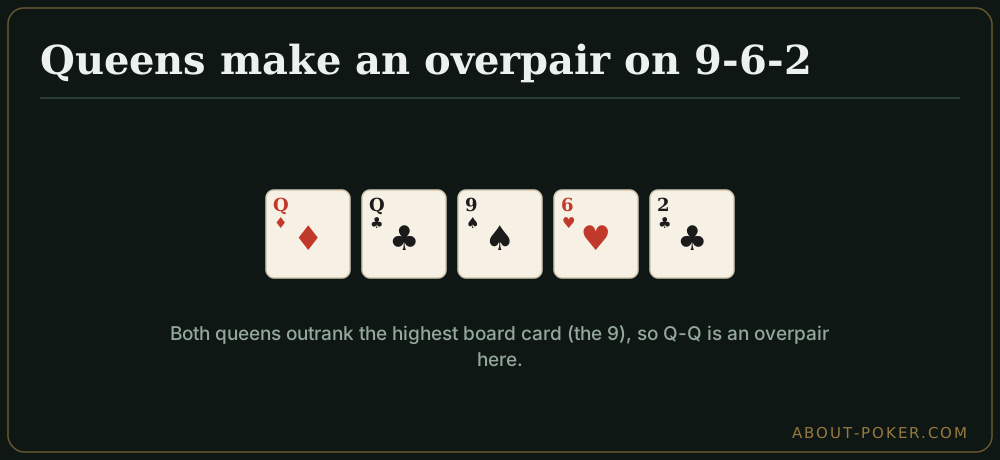
For a pocket pair to be an overpair, both cards must outrank the highest community card. J-J on a 10-7-3 board is an overpair. J-J on a Q-7-3 board is not — the queen outranks your jacks, so you now hold an underpair with a queen overcard working against you.
Aces are the ultimate overpair: A-A is an overpair on any flop that isn’t paired, because nothing outranks an ace. That’s part of why premium pocket pairs are so valuable — they flop an overpair the majority of the time.
Why an overpair is strong but not a monster
An overpair beats top pair, second pair, and every weaker one-pair hand outright. Against top pair top kicker — say A-K on a K-high board versus your overpair — you’re a solid favorite because your pair simply outranks their pair.
But an overpair loses to a lot of hands too: any set, two pair, straights, and flushes all have you crushed. As a rough benchmark, a set is roughly a 90% favorite over an overpair on the flop with two cards to come. So the hand is best understood as a strong bet-and-fold-sometimes hand, not an automatic stack-off.
Betting for value and protection
On most flops you want to bet your overpair. Two reasons:
- Value. Worse pairs, top-pair hands, and draws will pay you.
- Protection. Overcards and draws can outrun you, and charging them denies free equity. This is a classic protection bet situation.
A standard flop continuation bet of around half to two-thirds pot does both jobs. Betting bigger on wet boards (many draws) and smaller on dry boards (few draws) keeps your sizing efficient.
A worked hand
You open Q♣ Q♠ from the cutoff and the big blind calls. The flop is 9♦ 6♣ 2♥ — a dry, rainbow board. You have an overpair with essentially the best hand almost every time here.
Pot is 12 big blinds. You bet 7 (a bit over half pot). The big blind calls. Turn is the 5♠, bringing a gutshot to 7-8 but no flush. You bet again — around 16 into 26 — for value and to keep charging any pair or draw.
River is the 5♥, pairing the board. Now the board reads 9-6-2-5-5. Your overpair still beats one pair, but a check-raise or a big lead from the big blind should worry you, because 5-x now made trips and slowplayed sets got there long ago. Betting a third time for thin value is fine; calling a large raise usually is not. The overpair made money across three streets — you just didn’t let the last card turn a good hand into a bad call.
Common mistakes with overpairs
- Stacking off on every board. A single overpair is not worth 100 big blinds against a tight player who suddenly wants all the chips on an 8-7-6 two-tone board.
- Never folding aces or kings. Premium overpairs still fold on the worst runouts against the worst opponents. Discipline beats stubbornness.
- Playing them passively on dry flops. Checking your overpair “to trap” mostly gives free cards to hands that would have paid you anyway. Bet.
- Ignoring position. Out of position you’ll face more tough decisions on later streets, so lean toward smaller pots and clearer lines.
Quick checklist
Before you commit big with an overpair, ask:
- How dry or wet is the board? Dry favors value betting; wet favors caution.
- Does the aggression match a value hand that beats me (set, two pair, straight)?
- Am I up against a player who raises light, or one who only raises the nuts?
- Is this pair strong enough (aces, kings) to continue, or vulnerable enough (jacks, tens) to slow down?
Play the overpair as what it is — a strong one-pair hand — and it’ll be one of your most reliable earners.
Frequently asked
What is an overpair in poker?
An overpair is a pocket pair in your hand that is higher in rank than every card on the community board. For example, holding Q-Q on a 9-6-2 flop gives you an overpair because both your queens beat the highest board card.
Is an overpair better than top pair?
Yes. An overpair beats top pair top kicker in a showdown because your pair outranks the highest board card, whereas top pair only matches it. An overpair also has no kicker weakness on that pairing.
Should you always bet an overpair?
Usually yes on the flop, both for value and protection against overcards and draws. But you should slow down on scary turns and rivers where straights, flushes, or higher pairs become likely, since a single overpair rarely wants to stack off on the worst runouts.
Can an overpair be beaten?
Easily. Sets, two pair, straights, and flushes all beat a single overpair. That is why an overpair is a strong one-pair hand rather than a monster, and why board texture and bet sizing should guide how much you commit.