What Is Underpair in Poker?
An underpair is a pocket pair lower than the top board card. Learn how it differs from an overpair, its set-mining upside, and how to avoid bleeding chips with it.
On this page · 6 sections
An underpair is a pocket pair in your hand that ranks lower than the highest card on the board. Hold 8♣ 8♦ on a K♠ 7♥ 3♣ flop and you have an underpair of eights — the king beats your pair. It’s the mirror image of an overpair, and it’s a hand that quietly costs inexperienced players a lot of chips.
The definition, and why the same hand flips
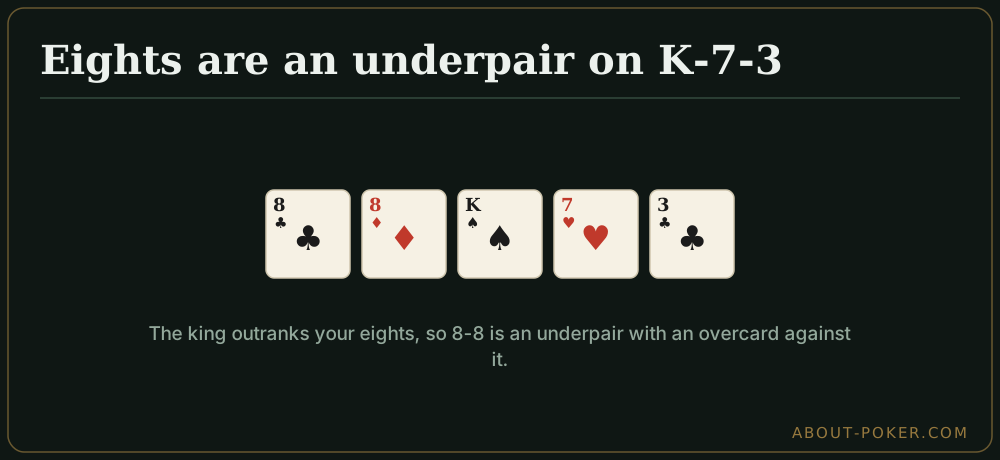
Whether a pocket pair is an underpair or an overpair depends entirely on the board. Take 8-8:
- On a 6-4-2 flop it’s an overpair — nothing beats your eights.
- On a K-4-2 flop it’s an underpair — the king is an overcard to your pair.
So “underpair” isn’t a property of your cards alone; it’s a relationship between your pair and the top of the board. Every unpaired flop that contains a card higher than your pair turns your pocket pair into an underpair.
How strong is an underpair?
Weak, in raw value. An underpair loses to top pair, to any bigger pocket pair, to sets, and to two pair. It only reliably beats hands that missed entirely — ace-high, king-high, busted draws.
That said, it’s not worthless. Its value comes from two places: it can win small pots at showdown against air, and it can occasionally spike a set and win a big one. A pocket pair improves to a set roughly 11.8% of the time by the river when it starts as an underpair on the flop — about one time in eight and a half.
How to play it: keep the pot small
The guiding rule with an underpair is pot control. You usually don’t want to bloat the pot, because most money that goes in will be against a better hand.
- In position, facing a check: a small stab can win the pot outright against air, but be ready to give up if called.
- Facing a bet: treat it as a bluff-catcher. Call one bet on dry boards if the price is right; fold to sustained aggression.
- Out of position: check and aim to reach a cheap showdown. Leading into a raiser with a low underpair mostly builds a pot you don’t want.
A worked hand
You call a cutoff open from the big blind with 6♦ 6♠. The flop comes A♣ 9♥ 4♦ — an ace-high board, so you have an underpair. The preflop raiser bets 5 into a pot of 11.
This is a marginal spot. Your sixes beat only the parts of their range that missed (some 7-6, K-Q, small suited hands). You can call once, planning to fold most turns. Say you call, and the turn is the 2♣. They bet again, 14 into 21. Now the picture is clear: they’re representing an ace or better, your underpair almost never improves, and there’s no reason to keep paying. Fold. You lost a small pot instead of a large one — exactly the outcome an underpair is designed to give you.
Contrast that with the flop being 6♣ 9♥ 4♦ instead. Now your sixes are a set, not an underpair, and you’d be happily raising for value. The single card difference is everything.
Common mistakes with underpairs
- Turning them into bluffs too often. A low pocket pair as a triple-barrel bluff usually just burns money; it has some showdown value you’re throwing away.
- Calling three streets “to see a set.” You already saw the flop — if it didn’t come, the implied odds are gone. Don’t chase.
- Overvaluing them multiway. In a family pot an underpair is nearly always beaten. Play it for set value only.
- Ignoring stack depth. Deep stacks reward set-mining preflop; short stacks kill the implied odds that make small pairs worth calling.
Quick checklist
- Is my pair below the top board card? Then it’s an underpair — think pot control.
- Do I have the price and stack depth to call for set value? If not, be quick to fold.
- Am I facing one bet (often callable) or sustained pressure (usually a fold)?
- Would a small stab win the pot now against a range that mostly missed?
Respect the underpair for what it is — a cheap showdown hand with a lottery ticket attached — and it won’t drain your stack. The players who bleed chips with underpairs are the ones who treat them like overpairs: calling three streets “because I have a pair” on a board loaded with overcards. Flip that instinct. When you hold a pair below the board, your default is to keep the pot small, hit your set, and fold the moment a passive opponent shows real aggression. Play it that way and an underpair becomes one of the cheapest, most profitable set-mining hands in your range instead of a slow leak.
Frequently asked
What is an underpair in poker?
An underpair is a pocket pair in your hand that is lower in rank than the highest card on the board. For example, holding 8-8 on a K-7-3 flop gives you an underpair, because the king outranks your eights.
What is the difference between an underpair and an overpair?
An overpair is a pocket pair higher than every board card, while an underpair is a pocket pair lower than the top board card. The same hand can flip between the two depending on the flop — 8-8 is an overpair on 6-4-2 but an underpair on K-4-2.
Should you bet an underpair?
Sometimes, but cautiously. An underpair rarely wants to build a big pot because it loses to top pair and everything above it. It is often best as a cheap showdown hand, a small bluff-catcher, or a hand you fold to real pressure.
Is an underpair worth calling with?
It can be if you have set-mining odds or a cheap chance to reach showdown. A small underpair still improves to a set roughly one time in eight on later streets, and that hidden upside is much of its value.