What Is Pace Of Play in Poker?
Pace of play is how quickly poker hands are dealt and decisions made. Learn about shot clocks, tanking, calling the clock, and good tempo etiquette.
On this page · 6 sections
Pace of play is a term you will hear at both casual home games and televised final tables, and it quietly shapes how much money you make and how much fun everyone has. In simple terms, pace of play is how quickly hands are dealt and how promptly players make their decisions. It sits at the intersection of etiquette, economics, and tournament rules.
What Pace of Play Means at the Table
Every hand of poker has a natural rhythm: cards are dealt, players act in turn, the pot is awarded, and the deck is shuffled for the next hand. Pace of play describes the tempo of that cycle. A brisk table might see 30 or more hands per hour; a slow one might see 20 or fewer. That difference is not trivial, because your hourly win rate is your win rate per hand multiplied by the number of hands you play.
Good pace is not about rushing. It is about acting promptly when you already know your decision, keeping chips organized so bets are easy to read, and not delaying the dealer. Thinking hard in genuinely difficult spots is fine and expected. Stalling in obvious ones is what damages the game.
Shot Clocks: Formalizing the Tempo
To keep tournaments moving, organizers increasingly use a shot clock, a fixed number of seconds to act on each decision. A common setting is 30 seconds per action. Many events pair this with time-bank chips, small tokens that each grant an extra block of time, often 30 or 60 seconds, so players can spend one on a truly critical decision without being rushed.
Shot clocks were once controversial but are now standard in high-stakes events because they solve a real problem. They prevent a single player from grinding the pace to a crawl and force everyone to develop the skill of making sound decisions under time pressure, which is a genuine part of the game.
Tanking and When It Becomes a Problem
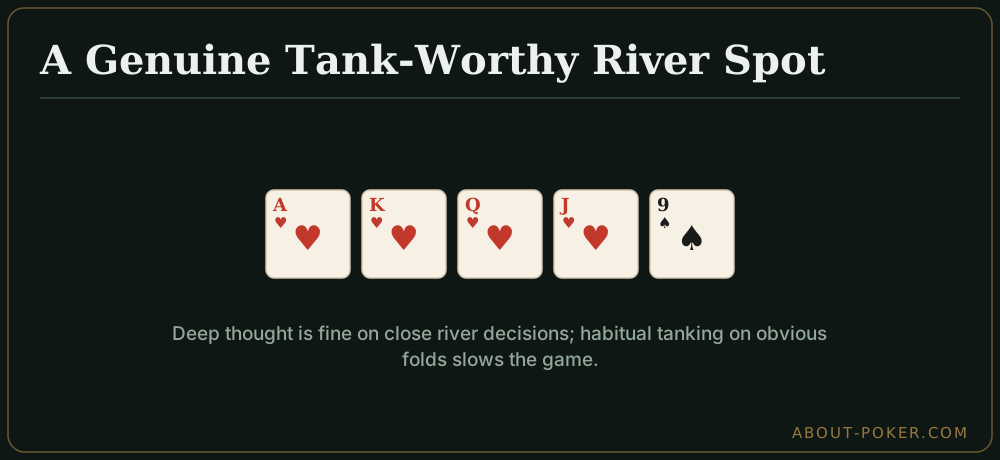
“Tanking” is the slang for going deep into thought before acting. A short tank on a big river decision is completely normal. The issue arises when a player habitually tanks on trivial decisions, folding a clear fold or calling an obvious call only after a long pause. This is sometimes done to project a false image, but more often it just annoys the table and slows everyone down.
Repeated needless tanking edges toward poor etiquette. It is not the same as a slow roll, which is deliberately delaying the reveal of a winning hand at showdown, but both stem from disregarding the pace and the other players at the table.
A Worked Example: Calling the Clock
Suppose you are in a tournament with no shot clock and a player has been thinking for over three minutes on a river decision that is clearly not worth that much deliberation. You can say to the dealer, “Time, please,” which asks the floor to call the clock. A typical procedure gives the player one additional minute, then the dealer counts down the final ten seconds aloud. If the player has not acted when the count reaches zero, their hand is declared dead if facing a bet, or treated as a check if there is no bet to call.
Calling the clock is a legitimate tool, not an insult. The key is to use it fairly: reserve it for genuinely excessive delays, not to needle an opponent who is a few seconds into a reasonable think. Weaponizing the clock to rattle someone drifts toward angle shooting, which is the opposite of good sportsmanship.
Good Pace Etiquette Checklist
Act promptly when your decision is obvious. Keep your chips stacked neatly so the dealer and opponents can read your bets instantly. Do not talk on the phone while it is your turn. Post your blinds and antes without being asked. Reserve deep tanks for the spots that truly deserve them, and lean on your time bank in tournaments rather than open-ended stalling. If someone is genuinely holding up the game, call the clock politely rather than sighing and complaining.
Why Pace of Play Matters to Your Bottom Line
Pace of play is not just courtesy; it is money. In cash games, more hands per hour means more chances for a winning player to profit and more rake generated, which is why casinos care about it too. In tournaments, a good pace keeps the structure meaningful and prevents short stacks from stalling into the money. Whether you are a beginner or a grinder, respecting the tempo of the game makes you a better table companion and, over the long run, a more profitable player.
Frequently asked
What is pace of play in poker?
Pace of play refers to how quickly hands are dealt and how promptly players act on their decisions. Good pace keeps more hands per hour running, which affects everyone's win rate and the enjoyment of the game.
What is a shot clock in poker?
A shot clock is a fixed time limit, often 30 seconds, that a player has to act on each decision. Many major tournaments use them, sometimes with time-bank chips that grant extra seconds for genuinely tough spots.
How do you call the clock on someone?
If a player is taking an unreasonably long time, you or another player can ask the dealer or floor to call the clock. The player is then given a set countdown, commonly one minute plus a short final count, after which their hand is dead if they have not acted.