What Is Squeeze Bluff in Poker?
A squeeze bluff is a light 3-bet against an open and one or more callers, using dead money and fold pressure to take the pot without a strong hand.
On this page · 7 sections
A squeeze bluff is a re-raise made after one player has opened and at least one other has called, using a hand too weak to want action. You are not 3-betting for value — you are bluffing, banking on the fact that both opponents fold far more often than they need to, letting you scoop the dead money already sitting in the pot. It is the bluffing half of the broader squeeze concept.
Why the Squeeze Works
The play is called a squeeze because the caller is trapped between the original raiser and your re-raise. Think about what the caller has told you: by flatting the open instead of 3-betting, they usually have a medium hand — good enough to see a flop cheaply, not good enough to raise. When you suddenly 3-bet over the top, that caller is now facing a raise with a hand that hates pressure, and there is still the original raiser to worry about. They fold a huge percentage of the time.
The original raiser folds a lot too. Their opening range is wide, and against a 3-bet plus a live caller, most of it cannot continue. Add up how often both players fold and you are frequently winning the open, the call, and the blinds without ever seeing a flop.
The Dead Money Is the Point
The extra chips from the caller — the “dead money” — are what make a squeeze bluff more profitable than an ordinary light 3-bet. With more already in the middle, your bluff risks a smaller amount relative to the reward. The squeeze play exists precisely because that caller sweetened the pot and revealed weakness at the same time.
A Worked Example
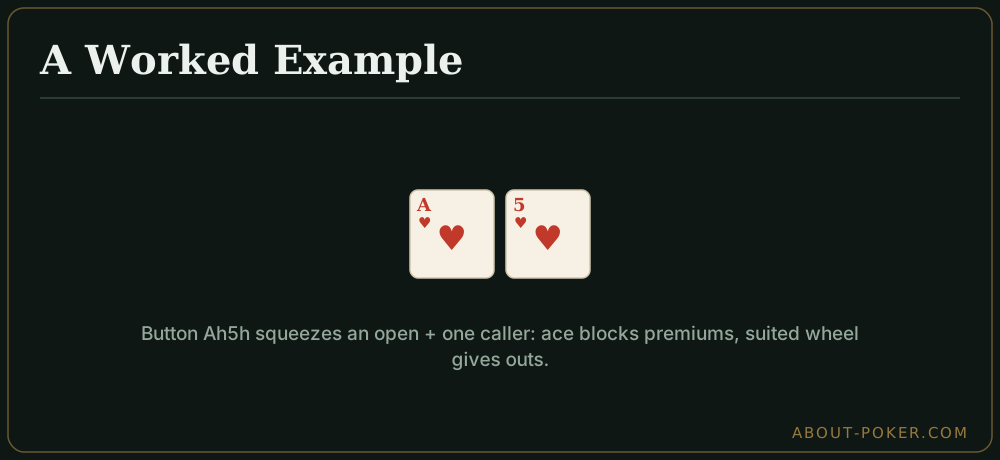
You are on the button with Ah 5h. A loose player opens to 3 big blinds from middle position. The cutoff, a straightforward player who never 3-bets light, calls. The pot now holds the open, the call, and the two blinds — about 8.5 big blinds of mostly dead money.
You squeeze to 11 big blinds. Consider the fold math: the cutoff called with a capped, medium range and almost never continues against a 3-bet and a live opener behind — call it a 75% fold. The original raiser folds most of a wide opening range, say 65%. If both fold as often as that, you take the pot without a flop the large majority of the time. And Ah 5h is an ideal squeeze bluff hand: the ace blocks many of the strong hands that would call, and on the rare occasion you get action, your suited ace can make the nut flush and a wheel straight, giving you outs and reverse-implied-odds protection.
What Makes a Good Squeeze Bluff Hand
The best squeeze bluffs are not random garbage — they are hands with two features:
- Blockers to premium holdings. Holding an ace or a king reduces the combinations of AA, KK, AK, and AQ your opponents can have, so you get called less.
- Playability if called. Suited hands make flushes and straights, so when a squeeze gets through only on the flop, you still have equity to fall back on.
Suited aces, suited broadways like KQs, and suited connectors are prime candidates. Offsuit trash like 9-4 makes a poor squeeze because it has no blockers and no backup equity.
When to Fire and When to Skip It
Squeeze bluff most when:
- The caller has a capped, flat-only range and folds to 3-bets.
- The original raiser opens wide and folds to pressure.
- You have position on the pot or good blockers.
- Stacks are deep enough that your 3-bet size threatens real damage.
Skip the squeeze when the caller is a station who never folds, when the raiser 4-bets aggressively, or when either player’s calling range is strong enough to punish you. Sizing matters too: because there are two opponents and dead money, size your squeeze a bit larger than a normal 3-bet — often around 4 times the open plus one extra bet per caller — so the price is high enough to fold out marginal hands.
Common Mistakes
The biggest error is squeeze bluffing into calling stations. If your opponents will not fold, you are just building a bloated pot with a weak hand. The second is under-sizing, which prices opponents in and defeats the purpose. The third is choosing hands with no blockers or no backup equity, so you get called by the exact hands you cannot beat and have nothing to fall back on.
Quick Checklist
- Has someone opened and at least one player flat-called? (Required setup.)
- Does the caller have a cappable, fold-prone range? (The target.)
- Does your hand have blockers and backup equity? (Best bluff selection.)
- Is your size large enough to fold out marginal hands? (Bigger than a standard 3-bet.)
Line those up and the squeeze bluff is one of the most reliable ways to turn other players’ dead money into your chips.
Frequently asked
What is a squeeze bluff in poker?
A squeeze bluff is re-raising (3-betting) after an opponent has opened and at least one other player has called, with a hand that is not strong enough to want a call. You are bluffing to fold out both the raiser and the caller and scoop the dead money already in the pot.
Why is it called a squeeze?
You 'squeeze' the caller between the original raiser and your re-raise. The caller has shown weakness by only calling, and now faces a raise and a still-live raiser behind or in front of them, so they fold very often — which is what makes the bluff profitable.
What hands make good squeeze bluffs?
Hands with blockers and some backup equity work best — suited aces, suited broadways, and suited connectors. Blockers to strong hands reduce the chance you get called, and the backup equity gives you outs on the rare occasions you do see a flop.