What Is Squeeze in Poker?
A squeeze in poker is a re-raise after an open and one or more callers. Learn what it means, why it works, when to do it, and how to size it correctly.
On this page · 7 sections
A squeeze in poker is a re-raise you make after someone has opened the pot and at least one other player has called that open. Instead of just calling behind, you raise, applying pressure to both the original raiser and everyone who flat-called. The name comes from the feeling you create: the caller is caught in the middle, “squeezed” between your raise and the original aggressor. It is one of the most profitable aggressive plays in no-limit hold’em when used at the right moments.
What a Squeeze Actually Is
Every squeeze has three ingredients: an open-raise, one or more flat-callers, and then your re-raise. The presence of the caller is what turns an ordinary 3-bet into a squeeze. A 3-bet against a lone raiser is just a 3-bet; add a caller in between and the same re-raise becomes a squeeze. The dead money from that caller is a big part of why the move is so strong, and it is closely related to the broader concept of the squeeze play.
Squeezes can be for value (you have a big hand like QQ+ or AK and want to build a pot) or as a bluff (you have a weak or speculative hand and want to win the pot uncontested). Good players use both, because if you only squeeze with monsters, observant opponents fold everything but their strongest holdings and you never get paid.
Why the Squeeze Works
The math behind the squeeze is about capped ranges and dead money. When a player just calls an open instead of 3-betting, they are usually saying “I have a decent hand, but not a premium one.” Their range is capped: no AA, KK, or AK, because those hands almost always re-raise. That capped, medium-strength range hates facing a big re-raise, so it folds often.
Meanwhile, the original raiser opened a wide range and now has to worry not only about you but about the caller still behind them. They fold most of their weak opens. And every time both players fold, you scoop the open, the call, and the blinds, all before the flop. That accumulated dead money is exactly what you are squeezing out.
A Worked Example
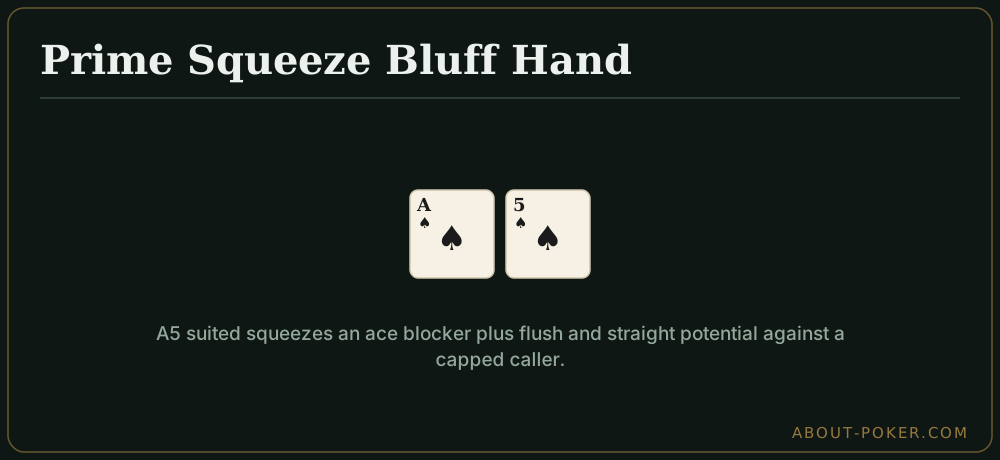
You are on the button in a 100 big blind cash game. A loose player opens to 3 big blinds from the hijack. The cutoff, a straightforward recreational player, flat-calls. It folds to you holding A5 suited.
The pot already contains 3 (open) + 3 (call) + 1.5 (blinds) = 7.5 big blinds. You squeeze to 12 big blinds. The original raiser folds their marginal open; the cutoff, capped and out of position to you, folds their pocket pair or suited broadway. You win 7.5 big blinds without seeing a flop. Even if you get called, A5 suited has an ace-blocker (making it less likely opponents hold AA or AK) plus flush and straight potential, so you can keep barreling on many boards. This is why hands like Ax suited and suited connectors are prime squeeze bluffs.
How to Size a Squeeze
Squeezes should be noticeably bigger than a standard 3-bet because there is more money to attack and more players to fold out. A reliable guideline:
- In position: raise to about 3 times the open, plus one extra open for each caller.
- Out of position: raise to about 4 times the open, plus one extra open per caller.
So against a 3 big blind open with one caller, an in-position squeeze might be 12 big blinds, while out of position it might be 13 to 15. Undersizing invites calls and defeats the purpose; a caller who was going to fold to 12 will happily call 8. When you have a genuine monster and want action, you occasionally cold 4-bet instead if someone re-raises your squeeze.
When to Squeeze and When Not To
Squeeze more often when:
- The opener is loose and the caller is passive or recreational (their ranges are weak and cap easily).
- You have position on both players.
- You hold blockers (an ace or a king) that reduce their premium combos.
Avoid squeezing when:
- The caller is a strong, tricky player who flats big hands to trap.
- Stacks are so short that you are effectively committing yourself with a weak hand.
- You will be out of position with a hand that plays badly postflop and has no blockers, like 96 offsuit.
Common Mistakes
The biggest error new players make is squeezing too small, which turns a fold-equity play into a bloated multiway pot with a weak hand. The second is squeezing too rarely, letting opponents call opens cheaply and realize their equity. A third is squeezing into calling stations who never fold; against them, tighten up and squeeze mostly for value, then bet your strong hands hard postflop.
Quick Checklist
Before you fire a squeeze, run through this:
- Is there an open and at least one caller? (If not, it is a plain 3-bet.)
- Are the ranges in front of me capped or weak?
- Do I have position, blockers, or a genuine value hand?
- Is my size big enough to fold out the caller?
- Do I have a plan for the times I get called?
Master those five questions and the squeeze becomes one of the most consistent pre-flop weapons in your game.
Frequently asked
What exactly is a squeeze in poker?
A squeeze is a re-raise made after one player has opened and at least one other player has called. You are 'squeezing' the money already in the pot by putting pressure on both the original raiser and the caller at once.
How big should a squeeze be?
Because there are more players and more dead money, squeezes are larger than normal 3-bets. A common rule is the size of a standard 3-bet plus roughly one extra open-raise for each caller. Out of position, use the bigger end of that range.
Can you squeeze with a bluff?
Yes. Many squeezes are semi-bluffs or pure bluffs using hands with blockers, like Ax or suited connectors. The play works because callers usually have capped, medium-strength ranges that struggle to continue against big pressure.