Playing a Gutshot Plus Overcards
How to play a gutshot plus overcards: counting your real outs, when to semi-bluff, when to check-call, and a worked flop example with equity numbers.
On this page · 6 sections
A gutshot with two overcards is the workhorse semi-bluff of no-limit hold’em. On its own a gutshot is a weak four-out draw, but add two overcards and possibly a backdoor flush, and suddenly you hold a hand with real equity and multiple ways to improve. The skill is in counting those outs honestly, knowing when to turn the hand into an aggressive semi-bluff, and knowing when to take a cheaper, patient line instead.
Counting your real outs
Start with the raw math. A gutshot is 4 outs to make a straight. Two overcards add up to 6 more outs to make top pair, since each unpaired overcard has three remaining cards. That is about 10 outs if everything is clean. Ten outs is roughly 20% equity with one card to come and about 38% with two cards to come. Add a backdoor flush draw and you can nudge that up a few points.
The honest part matters. Those overcard outs are only worth counting if pairing them actually makes you the best hand. Against a range that already contains sets, two pair, and better top pairs, your overcards may not be clean. Discount them when your opponent’s range beats top pair anyway; count them fully against a range of weak pairs and draws. This disciplined out-counting is the foundation of playing draws postflop.
When to semi-bluff
A gutshot plus overcards is a strong semi-bluff because betting gives you two paths to the pot: your opponent folds now, or you improve later. In position after your opponent checks or calls weakly, betting applies pressure while you still have a hand that can hit hard on the turn or river. The backdoor equity matters here too, because a card that gives you a flush draw or an open-ender lets you keep barreling credibly. That is why this hand class continues so well; see barreling the turn for how to follow through.
Compare it to a bare gutshot with no overcards, which has only 4 outs and much weaker follow-up equity. That hand is a marginal semi-bluff at best. The overcards and backdoors are exactly what elevate the combo to a proper aggressive candidate.
A worked example
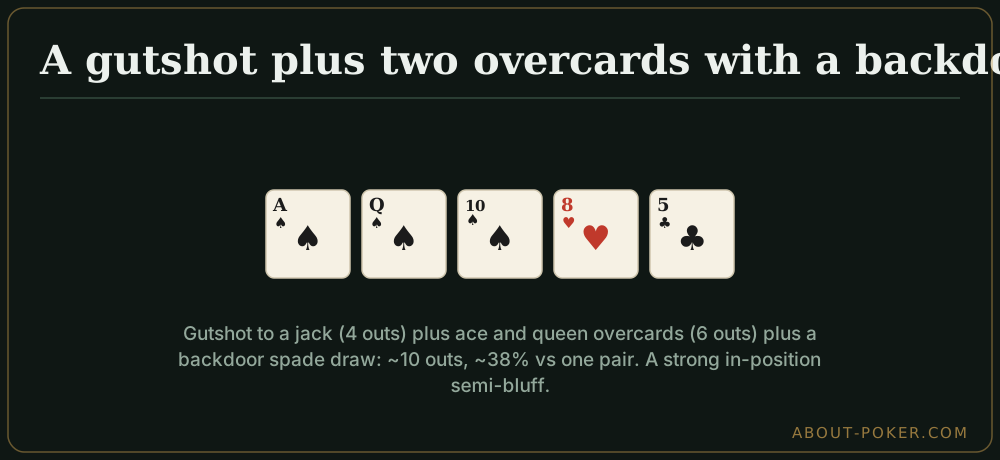
You call a cutoff open on the button with As Qs. The flop comes Ts 8h 5c. You have a gutshot to a jack, which completes your straight, plus two overcards in the ace and queen, plus a backdoor spade flush draw. Count it: 4 straight outs, 3 aces, 3 queens, so about 10 clean-ish outs, and the backdoor flush adds a bit more. That is roughly 38% equity against a single pair with two cards to come.
The cutoff c-bets and you have a choice. Calling is fine because your equity and position let you realize it cheaply, and a jack, ace, queen, or running spades all give you a hand you love. Raising is also strong as a semi-bluff, folding out the cutoff’s weak air and giving you the immediate pot sometimes while retaining all those outs when called. If you call and the turn brings a spade, you now have a flush draw on top of everything and can barrel if checked to, or continue against a bet. This flexibility is why a gutshot plus overcards is such a comfortable hand to float in position with.
Common mistakes
- Counting dead overcard outs. If your overcards pair into a hand that still loses, they are not real outs. Discount against strong ranges.
- Playing it purely passively. Never betting throws away the fold equity that makes the hand strong; a gutshot plus overcards wants to be aggressive at the right moments.
- Overcommitting out of position. Without position you realize equity worse and get barreled off your outs; be more willing to check-call and less eager to bloat the pot.
- Ignoring backdoors. The backdoor flush draw is what lets you keep firing on many turns; forgetting it makes you give up on cards where you should press.
Adjusting by position and opponent
In position, this is one of the best floating and semi-bluffing hands you can hold, because you control the pot and can barrel turns that improve you. Out of position, lean toward check-calling one bet and re-evaluating, since you cannot count on realizing your equity if you get raised. Against players who fold too much, the semi-bluff path is very profitable and you should raise and barrel more. Against calling stations, rely on the draw hitting rather than fold equity, and be cautious about firing big into a range that never folds.
Quick checklist for a gutshot plus overcards
- Count outs honestly: about 10 if the overcards are clean, plus backdoors.
- Discount overcard outs against ranges that already beat top pair.
- In position, semi-bluff by betting or raising to add fold equity.
- Out of position, prefer check-calling and re-evaluating on the turn.
- Track backdoor draws; they decide which turns you keep barreling.
Frequently asked
How many outs does a gutshot plus two overcards have?
A gutshot is 4 outs and two overcards add up to 6 more, for about 10 outs total if all the overcards are clean. That is roughly 20% equity on the turn with one card to come and around 38% with two cards to come, though you should discount the overcard outs when they might not be good.
Should you semi-bluff with a gutshot and overcards?
Often yes, especially in position with fold equity. A gutshot plus overcards has enough outs to improve to a strong hand and enough backdoor potential to keep barreling, so betting adds fold equity to your raw equity. It is a strong semi-bluff candidate compared with a bare gutshot.
Is a gutshot plus overcards worth calling a bet with?
Frequently, particularly with position and any backdoor flush draw. The combined outs give you real equity, and overcards can pair into the best hand while the gutshot can make a well-disguised straight. Discount the overcard outs against ranges that already beat top pair.