Playing a Straight Draw With Overcards
An open-ended straight draw plus two overcards can hold 12 to 14 outs and often over 50% equity. Learn the outs, when to shove, and a worked hand.
On this page · 6 sections
An open-ended straight draw is already a strong drawing hand, but pair it with two overcards and you often have one of the biggest hands you can hold without having made anything yet. This combination can carry 12 to 14 outs and frequently more than 50% equity against a made one-pair hand. That flips the usual passive approach to drawing: you’re not hoping to catch up, you’re the favorite, and you should play accordingly.
Counting the outs
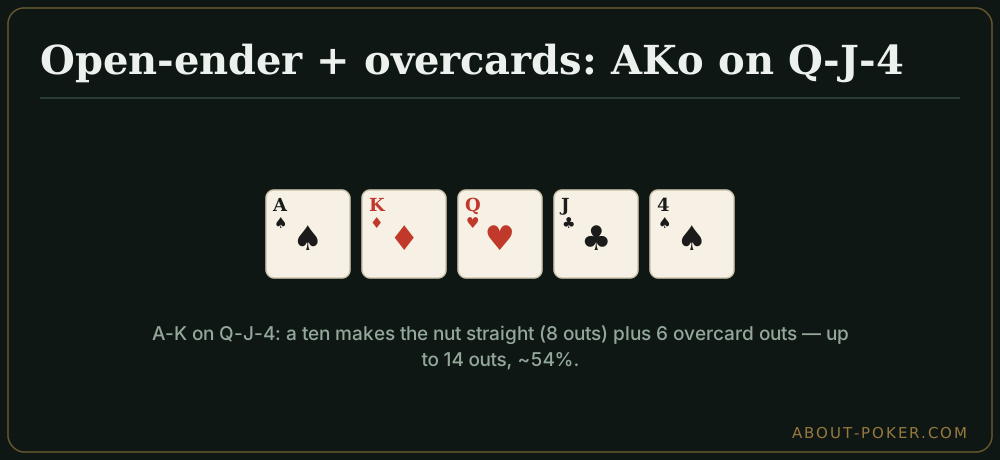
Start with the straight draw. An open-ended straight draw is eight outs. Now add the overcards: each unpaired overcard has three cards left that pair it, so two overcards add up to six more outs. Stack them and you have as many as 14 outs.
Fourteen outs is enormous. Using the rule of four (outs times four with two cards to come), that is roughly 54% equity from the flop to the river — a small favorite over a made pair. Even if you discount some overcard outs, a realistic 10 to 12 outs still puts you near a coin flip. For the general approach, see playing draws postflop, and for the weaker sibling hand see playing a gutshot plus overcards.
Not all overcard outs are clean
Before you treat every overcard out as gold, ask whether pairing actually wins. If your opponent holds an overpair, a set, or two pair, then pairing an ace or king still leaves you behind — those outs are “dirty.” On coordinated boards, pairing a card can also hand your opponent a straight or a flush completion.
So use a sliding scale. Against a wide, weak range, count all 14 outs and play the hand like the favorite it is. Against a tight range that continues only with strong hands, count mostly your eight straight outs and treat overcard outs as a bonus. Honest out-counting keeps you from overplaying a hand that has quietly lost half its equity.
Semi-bluff and get it in
With this much equity, passive play is a leak. You want to semi-bluff — bet and raise to combine fold equity with your huge drawing equity. When you check-raise a flop with 14 outs and stacks go in, you’re often a favorite against the very hands that call you: top pair, overpairs, and two pair. That’s the dream scenario, being ahead when called and still winning the pot outright a good share of the time when they fold.
This is why the open-ender-plus-overcards is a premium candidate for check-raise all-in lines and turn shoves. It plays much like the pure straight draw semi-bluffs covered in semi-bluffing a straight draw, only with even more equity behind it. The bigger your equity, the more comfortably you can commit stacks.
Position and stack depth
In position, you can bet, take free cards when needed, and control the pot while keeping the initiative. Out of position, favor the check-raise: it lets you play the hand aggressively without simply leading into an uncapped range. Deeper stacks reward semi-bluffing because your fold equity and implied odds are higher; shorter stacks make getting all in cleaner since there is less room to be bluffed off later streets.
Also consider the opponent. A calling station kills your fold equity, so lean on the raw equity and pot odds rather than the fold. A tight, aggressive player folds more, boosting the semi-bluff’s value.
A worked hand
You raise on the button with A-K offsuit and the big blind calls. The flop is Q-J-4 rainbow. You have two overcards and an open-ended straight draw (a ten makes A-K-Q-J-10, a straight to the ace). That’s eight straight outs plus six overcard outs — up to 14 outs, roughly 54% equity against a hand like top pair.
The big blind checks and you c-bet two-thirds pot. The big blind check-raises. Given your enormous equity, folding would be a mistake — you’re a favorite against most of their check-raising range. You can call to keep their bluffs in and realize your equity, or, if stacks are shallow enough, shove and get it in as the favorite.
Say you call. The turn is the ten of clubs — you make an ace-high straight, the near nuts. Now you’re purely value betting and getting stacks in for profit. Even on the turns you miss, you played a hand that was ahead the whole way, which is exactly why an open-ender with two overcards is a hand you press, not protect.
Quick checklist
- Count 8 straight outs plus up to 6 overcard outs — as many as 14.
- Discount overcard outs against overpairs, sets, and coordinated boards.
- Semi-bluff hard: bet, check-raise, and be willing to get it in as a favorite.
- Play in position with bets; play out of position with check-raises.
- Against stations, lean on equity; against tight players, lean on fold equity.
Frequently asked
How many outs does a straight draw with overcards have?
An open-ended straight draw plus two overcards has up to 14 outs — 8 for the straight plus 6 for pairing either overcard. In practice you often count fewer overcard outs because pairing may not give you the best hand, but even a conservative estimate leaves you with 10 to 14 outs.
Is an open-ender with two overcards a favorite?
Frequently, yes. With 14 clean outs you are roughly 54% by the river from the flop, which makes you a small favorite against a made one-pair hand. Even with a conservative 10 to 12 outs you are close to a coin flip, so aggression is strongly favored.
Should you get all in with a straight draw and two overcards?
Often yes. When your outs are clean and you hold enough equity — near or above 50% — getting the money in on the flop or turn is profitable because you have both fold equity and a real chance to win when called. Discount overcard outs against stronger ranges.
When are overcard outs not clean?
Overcard outs shrink when pairing your card still leaves you behind — for example against an overpair, a set, or two pair — or when the board is coordinated enough that a pair does not win at showdown. In those spots count mostly your straight outs.