Playing Broadway Flops
Broadway flops like A♦K♣Q♠ hammer the preflop raiser's range and reward high-frequency c-bets. Learn who has the nut advantage and how to attack high boards.
On this page · 7 sections
Broadway flops — boards built from high cards ten through ace, like A♦K♣Q♠ or K♥J♦T♣ — are where the preflop raiser’s range advantage reaches its peak. Your raising range is stuffed with exactly these cards, so you flop top pairs, overpairs, and the very best hands at a rate the caller cannot match. Handled correctly, high boards are among the most profitable to c-bet. The one wrinkle is connectivity: a dry Broadway board plays very differently from one that also makes straights.
Why You Own the Range Advantage
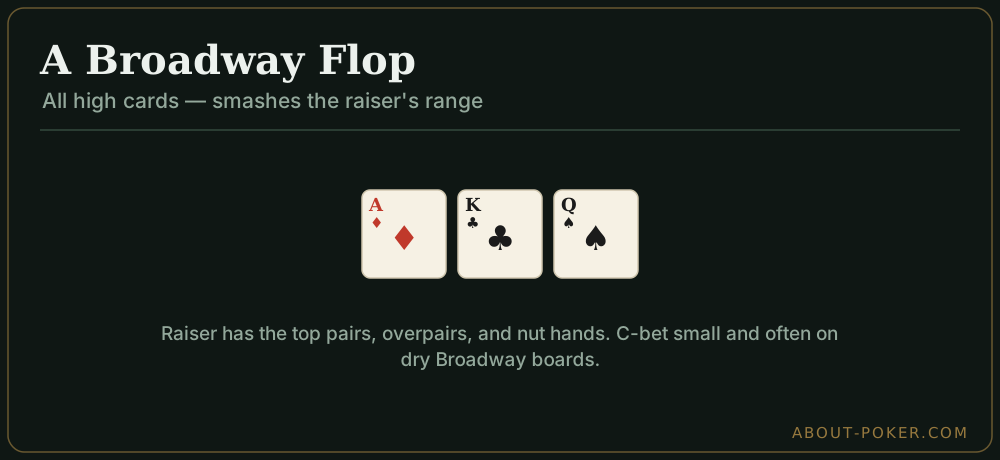
When you open A-K, A-Q, K-Q, K-J, and every big pair, and get called, a board like A♦K♣Q♠ smashes your range. You have all the top pairs with strong kickers, the overpairs, and the nut hands like two pair and sets. The caller, defending wider from the blinds, shows up with fewer of these combinations and a lot of hands that simply miss high, dry boards. That imbalance — both a range advantage and a nut advantage — is the strongest possible license to bet, and the board texture and range advantage page explains why it translates directly into aggression.
Dry Broadway Boards: Bet Small, Bet Everything
On a disconnected Broadway board such as A♦K♣7♠ or K♥Q♦4♣, treat it like any other dry flop c-bet: small size, very high frequency. A one-third-pot bet across most of your range punishes the caller’s air, denies equity to their overcards and gutshots, and sets up cheap barrels. Because you have so many nut hands, your bluffs are well protected — your opponent cannot profitably raise into a range this strong.
A Worked Example
You open A♣J♣ from the cutoff, the big blind calls, and the flop comes A♦K♣7♠. You have top pair with a good kicker plus the nut-flush backdoor. This is a mandatory small c-bet. You are ahead of every worse ace, every king, and all of the caller’s floats, and betting builds a pot you will usually win while charging the six outs of a hand like Q-J for its gutshot. Managing top pair from here is its own topic, covered in playing top pair.
Contrast this with the same A♣J♣ on K♥Q♠J♦. Now you have only middle pair on a fully connected Broadway board where the caller can easily hold A-T for the nut straight or T-9 for an open-ender. Your license to fire evaporates — this is a check-and-control spot, not a bet-every-time spot.
Connected Broadway Boards Need a Gear Change
The trap on Broadway boards is treating K-Q-J or Q-J-T the same as A-K-7. Connected high boards still favor you, but the caller can now hold made straights and strong draws, so you must size up and tighten your betting range. On these textures, bet larger — half to two-thirds pot — with your genuine value and your best draws, and check back marginal made hands that would rather see a cheap showdown than bloat a pot into a range that can raise.
Barreling Turns on High Boards
Because you hold so many nut combinations on Broadway boards, your turn barrels carry extra credibility, and a large chunk of the caller’s flop-calling range is weak pairs and floats that cannot withstand a second bet. On dry Broadway boards, keep applying pressure on blank turns with your value and your best bluffs — the caller rarely improved, and your range still crushes theirs. A turn that pairs the board or brings another high card usually improves your range more than the caller’s, so it is a green light to fire again. The turns to slow down on are the ones that complete obvious draws on connected boards, where the caller’s peels finally get there.
Common Mistakes
The most common leak is under-betting your range advantage on dry Broadway boards out of respect the caller has not earned — checking back hands that should be firing small and often. The opposite leak appears on connected Broadway boards: continuing to spew small c-bets into a range that now connects, and running into check-raises from straights and combo draws. Read the connectivity first, then choose your size.
Checklist for Broadway Flops
- Recognize your range and nut advantage — big-card boards favor the raiser strongly.
- On dry Broadway boards, c-bet small (about one-third pot) at a high frequency.
- On connected Broadway boards, size up and tighten your betting range.
- Fire barrels freely with top-pair-good-kicker and better on dry high boards.
- Do not autopilot small c-bets into K-Q-J type boards where the caller can hold straights.
Frequently asked
What is a Broadway flop?
A Broadway flop is a board made of high cards ten through ace, such as A♦K♣Q♠ or K♥J♦T♣. These boards connect strongly with the big-card hands that make up a preflop raiser's range, giving the raiser a large range and nut advantage.
Who has the advantage on a Broadway board?
The preflop raiser, decisively. Raising ranges are full of Broadway cards and premium pairs, so the raiser hits top pair, overpairs, and the nut combinations far more often than a caller who defended with a wider, weaker range.
How should you c-bet a Broadway flop?
Bet at a high frequency. On dry Broadway boards use a small size across most of your range; on connected Broadway boards like K-Q-J, size up and be a bit more selective because the caller can hold straights and strong draws.