Playing Disconnected Flops
Disconnected flops have no straight draws and few surprises. Learn how to range-bet these blank boards, defend as the caller, and read the turn correctly.
On this page · 7 sections
A disconnected flop is one where the ranks are so far apart that no straight draw exists — boards like K-8-3, Q-7-2, or A-9-4. Nothing on the board threatens to make a straight, and if the suits are rainbow there is no flush draw either. That absence of draws makes these among the most static, predictable textures you will ever play, and once you understand why, they become some of the easiest pots to win.
What “Disconnected” Actually Means
Connectedness is about how close the ranks sit. A board like 9-8-7 is maximally connected — it already contains a made straight and dozens of straight draws. Slide the ranks apart to 9-6-3 and the straight draws thin out. Spread them all the way to K-8-3 and straights become nearly impossible: no two cards in a normal range make a straight, and no single turn card creates a meaningful straight draw.
Disconnection is closely tied to dryness, but they are not the same axis. Dryness folds in the suit pattern too — a fully dry board is both disconnected and rainbow. A disconnected two-tone board like K♥-8♥-3♣ still has a flush draw even though it has zero straight potential. For the broader framework of how texture shapes every decision, the wet vs dry board texture guide is the place to start.
Why These Boards Favor the Raiser
Because the ranks are high-and-spread, disconnected flops usually feature a broadway card that connects with a raising range. On K-8-3 the preflop raiser holds every king combo, plus overpairs with aces and queens. The caller, who only flatted, has few kings, is missing the top aces, and connects with the 8 and 3 only weakly. Run the two ranges and the raiser holds a comfortable equity lead — see range vs range on dry boards for the exact split. That lead, plus the lack of draws to protect against, is the whole reason you can bet cheaply and relentlessly.
How to Bet a Disconnected Flop
If the board is disconnected and rainbow, treat it like the driest of dry boards: c-bet small, around one-third pot, with a very high frequency approaching your entire range. There is nothing to charge and nothing to protect against, so a small bet extracts folds from air and thin value from worse pairs while risking almost nothing — the same logic covered in c-betting dry flops.
If the board is disconnected but two-tone, size up a touch — a one-third bet still works but you may lean toward the higher end because now a flush draw exists to charge. The straight side of the board is dead either way, so your bet is really only accounting for the flush draw.
A Worked Example
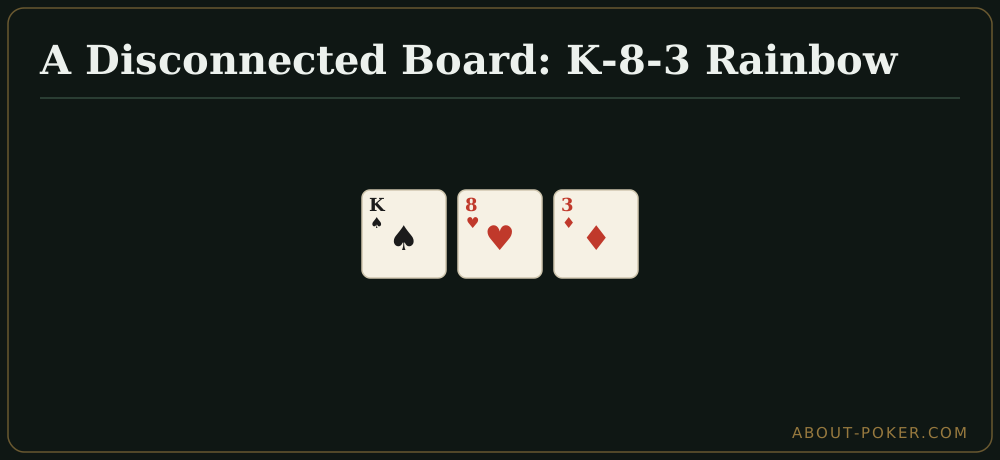
You open K♦Q♣ from middle position, the button calls, and the flop is K♠-8♥-3♦ rainbow. The pot is about 6bb. You hold top pair, second kicker, on a board with no straight draws and no flush draw.
You bet one-third, roughly 2bb. Notice the beauty of this spot: there is essentially no bad turn card. No card completes a straight, no card completes a flush, and only an ace or a second pairing card (an 8 or a 3) even mildly threatens you. So you bet, get called by worse kings and pocket pairs, and plan to keep betting most turns for value. If the button raises, you have an easy decision because their raising range is narrow — sets and the occasional pure bluff — and you can fold your one-pair hand without agonizing. The board’s simplicity is doing the work for you.
Playing Disconnected Flops as the Caller
Defense is straightforward. Against a small bet, call with any pair, ace-high with a backdoor draw, and hands that can pick up equity. Fold your complete air — on K-8-3 there is nothing to draw to, so floating with nothing rarely pays off. Because the board is static, raising is mostly reserved for value; a bluff-raise here turns your hand face-up and gets called by the raiser’s strong range too often. When you do continue, plan to reevaluate on the turn, since blank turns keep the aggressor firing and you will often be folding by the river without improvement.
Common Mistakes
- Overbetting a board with nothing to charge. A big bet on K-8-3 rainbow burns money — the small size already folds out the air.
- Floating with pure air as the caller. With no draws, a naked float cannot improve; you are just donating.
- Giving up on blank turns as the aggressor. Disconnected boards stay static, so your turn equity holds — keep barreling.
- Bluff-raising a static board. Without protection value or fold equity from the aggressor’s strong range, the check-raise bluff simply loses over time.
Disconnected-Flop Checklist
Run the board through four questions: Are the ranks spread far enough that no straight draw exists? Is it rainbow (truly dry) or two-tone (a flush draw to account for)? Do I hold the range advantage as the raiser — and can I bet small and often? As the caller, do I have a pair or backdoor equity worth continuing, or is this a clean fold into a static, raiser-favored board? Those four questions turn disconnected flops into some of the most automatic profit in your postflop game.
Frequently asked
What is a disconnected flop?
A disconnected flop has ranks spread far apart so no straight draws exist — for example K-8-3 or Q-7-2. Combined with a rainbow suit pattern, these boards offer almost no draws, making them among the most static and predictable textures in poker.
How do you play a disconnected flop?
As the preflop raiser, bet small and often — the board rarely helps the caller and your high cards give you a range edge. As the caller, continue with pairs and backdoor equity and fold your total air, since there is little to draw to.
Are disconnected and dry flops the same thing?
Closely related but not identical. Disconnected refers to the ranks having no straight potential; dry usually means no draws at all, including no flush draw. A disconnected board can still be two-tone, which adds a flush draw and changes your sizing slightly.