Playing Draws in a 3-Bet Pot
Playing draws in a 3-bet pot is all about SPR: shallow stacks mean commit or fold. Learn when to jam, when to fold, and how equity changes the math.
On this page · 7 sections
Draws behave completely differently in a 3-bet pot than in a single-raised pot. The reason is one number: the stack-to-pot ratio. When money went in preflop three times, the pot is already large relative to what’s left behind, and a flush draw stops being a “see a cheap card” hand and becomes a commit-or-fold decision. Understanding this shift is the difference between realizing your equity and getting blown off it.
Why SPR changes everything
SPR — stack-to-pot ratio — is the effective stack divided by the pot on the flop. In a single-raised 100bb pot the flop SPR is often around 10, giving you room to call, float, and chase draws cheaply. A 3-bet pot compresses that math hard. If both players start 100bb and the pot is 3-bettting to ~24bb preflop, you reach the flop with roughly 76bb behind into a ~48bb pot — an SPR near 1.5.
At that SPR, one pot-sized bet on the flop and a shove on the turn gets the money in. There’s no room to “just call and see the river.” So a draw is no longer a passive hand you nurse to showdown; it’s a hand that either commits now with equity and fold equity, or folds. This is the core idea that carries over from playing draws postflop but with the stakes turned up.
The equity math for common draws
Know your outs and your equity before you decide. Standard figures on the flop, with two cards to come:
- Flush draw (9 outs): about 35% equity to make the flush by the river.
- Open-ended straight draw (8 outs): about 32%.
- Flush draw + one overcard read as live: roughly 45%.
- Combo draw — flush draw + open-ended (15 outs): about 54%, often a favorite versus a single made hand.
The rule of 4: multiply your flop outs by 4 for an approximate percentage to hit by the river. Nine outs times four is 36 — close to the exact 35%. These numbers matter because at low SPR you frequently get all the money in, and your equity when called determines whether the shove is profitable even before you add fold equity.
Worked hand: jamming a flush draw
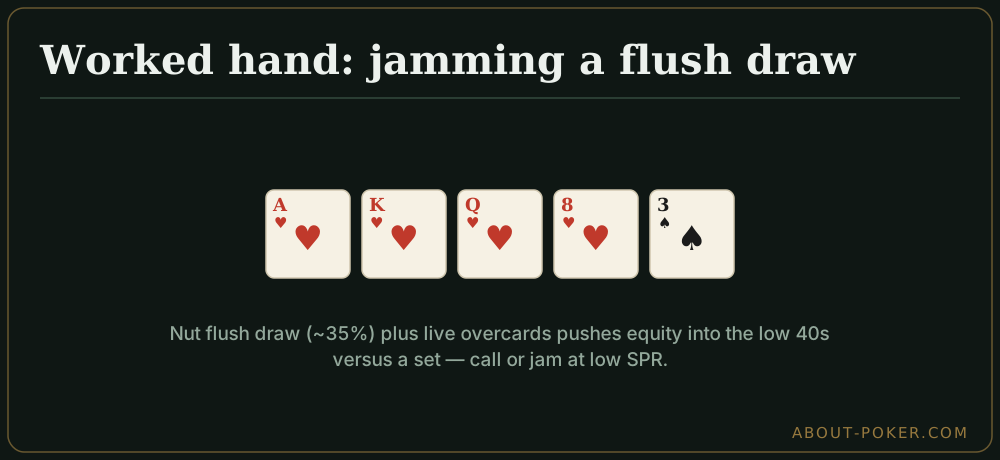
You 3-bet A♥ K♥ from the button; the cutoff calls. Effective stacks 100bb. Pot is 48bb going to the flop, leaving ~76bb behind — SPR about 1.6. Flop comes Q♥ 8♥ 3♠. You have the nut flush draw plus two overcards.
You c-bet a wet flop — say two-thirds pot, ~32bb — and the cutoff jams. You’re getting laid a price: call ~44bb to win a pot of roughly 156bb, needing about 28% equity. Your nut flush draw alone is 35%, and your overcards add more live outs, pushing you toward the low-to-mid 40s against a set or two pair. You’re getting the price and then some. Call. Better still, on many flops you should be the one jamming rather than betting small — folding out his weaker made hands captures fold equity on top of your raw equity, and it stops him from raising you off a hand that’s nearly a coin flip.
Semi-bluff, don’t nurse
The biggest mistake at low SPR is betting small with a draw and getting raised off it. When you can’t profitably continue against a raise, you’ve turned a strong hand into a fold. The fix is to take the aggression yourself. Jamming or betting large with your draw does two jobs at once: it denies your opponent the chance to raise you off your equity, and it wins the pot outright when they fold their unpaired overcards or weak pairs.
This is why draws are natural semi-bluff candidates in 3-bet pots. You almost never want to check-call a draw down passively — the pot is too big relative to stacks to realize equity cheaply, and folding a 35% hand into a bloated pot is a disaster. Commit or fold, and lean toward commit when you hold a strong draw with clean outs.
When to fold instead
Not every draw is a jam. Fold when:
- Your outs are dirty. A flush draw on a paired board can be drawing to a losing flush against a full house. Discount your equity.
- You’re drawing to the second-best hand. A low straight draw when a higher straight is possible, or a non-nut flush draw on a board where a bigger flush is likely.
- The board smashes your opponent’s 3-bet-calling range. If they flatted your 3-bet and the flop is all broadways, they connect hard; your fold equity drops and your outs may not be clean.
- Effective stacks are deep and the SPR is high. In the rare deep-3-bet-pot, you can call and play a normal draw. But that’s the exception, not the rule.
Checklist for draws in 3-bet pots
Run this before you act:
- What’s the SPR? Below ~2, treat draws as commit-or-fold.
- How many clean outs do I have? Multiply by four for river equity; discount dirty outs.
- Nut or non-nut draw? Nut draws jam freely; non-nut draws need more caution.
- Do I have fold equity? Overcards and unpaired ranges fold; jam. Sticky made-hand ranges call; jam only with big equity.
- Am I the aggressor? If yes, prefer jamming over a small bet you’d have to fold to a raise.
Putting it together
In a 3-bet pot, draws are decided by SPR, not by hope. The pot is big, the stacks are shallow, and there’s no room to passively chase — so you either commit with your equity plus fold equity or you let the hand go. Anchor to your out count, respect nut versus non-nut, and take the initiative rather than betting small and getting raised off a monster draw. Build the foundation with playing draws postflop, master the biggest weapons in combo draws, and head back to the postflop hub to tie it all together.
Frequently asked
How do you play a flush draw in a 3-bet pot?
Because 3-bet pots are shallow, a flush draw is usually a commit-or-fold hand. With a strong draw and low SPR, semi-bluffing all in is often best: you have around 35% equity plus fold equity. With deep effective stacks you can call and see a card, but shallow you should rarely just call and give up.
What is SPR and why does it matter for draws?
SPR is the stack-to-pot ratio — remaining effective stack divided by the pot on the flop. 3-bet pots create a low SPR, often 1 to 3. Low SPR means one bet commits you, so draws become jam-or-fold hands rather than call-and-realize-equity hands.
Should I semi-bluff shove draws in a 3-bet pot?
Often yes. At low SPR a flush or combo draw has enough raw equity that even when called you're not far behind, and the fold equity from shoving adds value. Jamming is usually better than a small bet that lets you get raised off your equity.
Do combo draws change the strategy?
Significantly. A combo draw like a flush draw plus a straight draw or two overcards can have 45% or more equity against a strong made hand. At that point getting all in is close to a coin flip, and the fold equity makes shoving clearly profitable.