Playing Rainbow Flops
Rainbow flops have three suits and zero flush draw. Learn how the missing flush changes your c-bet sizing, barreling plan, and defense on these boards.
On this page · 7 sections
A rainbow flop is any board that comes down in three different suits, so no two cards match and no flush draw exists. That single feature — the missing flush draw — quietly removes one of the biggest sources of the caller’s equity and reshapes how you bet. But rainbow does not mean automatically safe, and the players who treat every rainbow board as bone dry give away pots on connected textures. The key is reading the suits and the ranks together.
What Rainbow Changes
Suit pattern is one of the four axes of board texture, and rainbow sits at the driest end of it. On a two-tone board a flush draw gives the caller roughly nine outs and a big chunk of continuing equity; on a monotone board a flush is already possible. Strip the board to rainbow and all of that vanishes — there is simply no flush to draw to or to fear. For the full contrast between suit patterns, c-betting monotone boards shows the opposite extreme, where three of a suit forces you to protect and size up dramatically.
Because the flush is off the table, rainbow boards are cheaper and safer to attack. Your value hands get outdrawn less often, your bluffs face fewer sticky draws, and blank turns stay blank. The whole wet vs dry board texture framework leans dry the moment a board is rainbow.
Rainbow Is Not the Same as Dry
Here is the trap: rainbow removes the flush draw, but it says nothing about the ranks. A board can be rainbow and still be soaking wet on the straight axis. Consider 9♠-8♥-7♦ rainbow. There is no flush draw at all, yet this board is packed with straight draws — any six, any ten, any jack, and every made straight combo lives in the caller’s range. A player who sees “rainbow” and fires a tiny one-third bet is letting a mountain of straight draws call cheaply and outdraw them.
So read both dimensions. Disconnected rainbow (K-7-2, Q-8-3) is genuinely dry — bet small and often. Connected rainbow (9-8-7, T-9-6) is wet on straights only — size up to charge those draws even though the flush is impossible.
How to Bet Rainbow Boards
Disconnected rainbow. Treat it like the driest board in the deck. C-bet small, around one-third pot, at a very high frequency — often approaching your whole range. Nothing draws, nothing protects, so a cheap bet folds air and extracts thin value while risking almost nothing. This is the classic range bet detailed in c-betting dry flops.
Connected rainbow. Size up to half or two-thirds pot and bet a more selective, polarized range. You still have to charge the straight draws and protect your made hands; the only difference from a fully wet board is that you can ignore the flush entirely, which slightly widens the range of turn cards that are safe for you.
A Worked Example
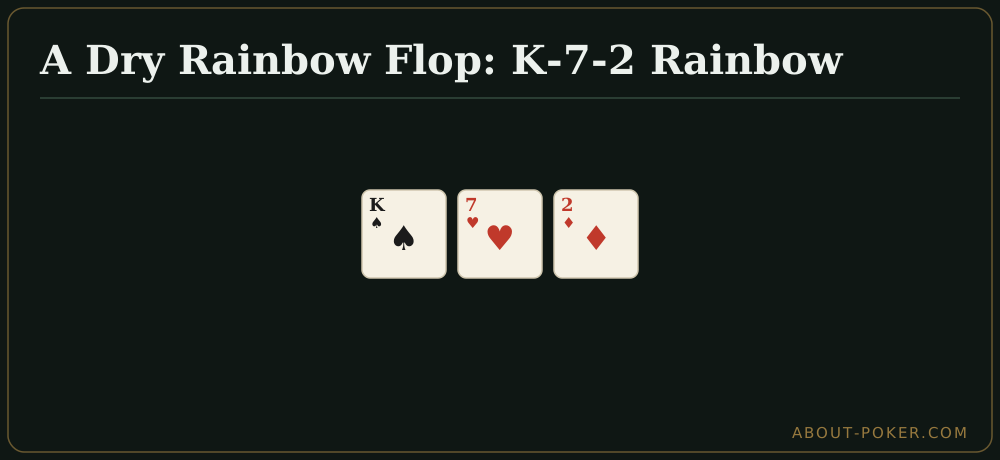
You open A♣K♦ from the cutoff, the big blind calls, and the flop is K♠-7♥-2♦ rainbow. The pot is about 5.5bb. Read it: disconnected, rainbow, one high card — bone dry and yours. You hold top pair, top kicker.
Bet one-third, about 1.8bb. There is no flush draw and no straight draw, so essentially no turn card threatens you except an ace pairing the caller or a runner-runner miracle. You will get called by worse kings and pocket pairs, fold out the air, and keep barreling nearly every turn for value. Now swap the flop to K♠-Q♥-J♦ rainbow with the same A-K: still no flush draw, but suddenly every ten makes a straight and the board is loaded with draws. You would size up to protect, because the ranks — not the suits — now dictate the danger.
Playing Rainbow Flops as the Caller
On disconnected rainbow boards, defend tight: call your pairs and backdoor equity against a small bet, and fold your air, since there is nothing to draw to. Raising is mostly for value on these static boards. On connected rainbow boards, lean on your straight draws — call and semi-bluff-raise with open-enders and combo draws, because you retain real equity even though a flush is impossible. In both cases, remember the aggressor’s turn barrels are more credible on rainbow boards, since scare cards are limited to straight-completers and overcards rather than flush cards too.
Common Mistakes
- Treating every rainbow board as dry. Connected rainbow boards are wet on straights — betting tiny lets draws call cheap.
- Overbetting a disconnected rainbow. With nothing to charge, a big bet on K-7-2 rainbow just wastes chips.
- Fearing the flush on rainbow turns. No flush can complete when the board is rainbow through the flop — do not slow down over a scare card that cannot exist yet.
- Floating with pure air on dry rainbow boards. No draws means no way to improve; folding is correct.
Rainbow-Flop Checklist
Two questions cover it. First: is the board disconnected (dry — bet small and often) or connected (wet on straights — size up to charge them)? Second: given no flush draw exists, which turn cards actually threaten me — only straight-completers and overcards? Answer both and rainbow boards become a clean, two-part read: the suits tell you the flush is dead, and the ranks tell you everything else.
Frequently asked
What is a rainbow flop?
A rainbow flop shows three different suits, so no two cards share a suit and no flush draw is possible on the flop. Removing the flush draw eliminates a huge chunk of the caller's continuing equity, which is why rainbow boards are cheaper to attack.
How do you play a rainbow flop?
It depends on the ranks. A disconnected rainbow board like K-7-2 is bone dry — bet small and often. A connected rainbow board like 9-8-7 rainbow still has straight draws, so size up to charge them even though no flush is possible.
Is a rainbow flop always dry?
No. Rainbow only means no flush draw; the ranks still matter. K-7-2 rainbow is fully dry, but 9-8-7 rainbow is wet on the straight axis with plenty of open-enders and gutshots to protect against. Read the ranks and the suits together.