What Is Four Bet Pot in Poker?
A four-bet pot is a big preflop pot after a raise, 3-bet and 4-bet. Learn who has range advantage, why SPRs are low, and how to play the flop.
On this page · 6 sections
A four-bet pot is one of the biggest and most misunderstood spots in No-Limit Hold’em. If you know what a 4-bet is, the pot type is simply the natural consequence: a hand where the preflop action escalated all the way to a fourth raise before anyone saw a flop. These pots play very differently from single-raised or 3-bet pots, and misplaying them is one of the fastest ways to donate a stack.
What “Four Bet Pot” Actually Means
Count the aggressive actions preflop. The opening raise is the first bet. A re-raise is the second bet, commonly called a 3-bet. A re-re-raise is the third re-raise but the fourth bet overall, which is why it is called a 4-bet. When one player 4-bets and gets called (or someone shoves and gets called), you are now in a four-bet pot.
The key word is “pot,” not “bet.” The 4-bet describes an action; the four-bet pot describes the hand you then play out. By the time the flop arrives, a huge fraction of the effective stacks is already in the middle, and that changes almost every decision you make.
Why the Pot Is So Big and the SPR Is So Low
The defining feature of a four-bet pot is a low stack-to-pot ratio (SPR). SPR is simply the effective stack behind divided by the current pot. In a typical 100bb cash game, a 4-bet to around 22bb that gets called leaves you with roughly 78bb behind and a pot near 45bb, an SPR of under 2.
That matters enormously. With an SPR of about 1.75, top pair or an overpair is usually a stack-off. There is no room to bet the flop, turn, and river in three escalating streets, so multi-barrel bluffing loses much of its power. The math pushes hands toward “get it in or fold” far more often than in a deeper pot.
Range Advantage: Who Holds the Whip Hand
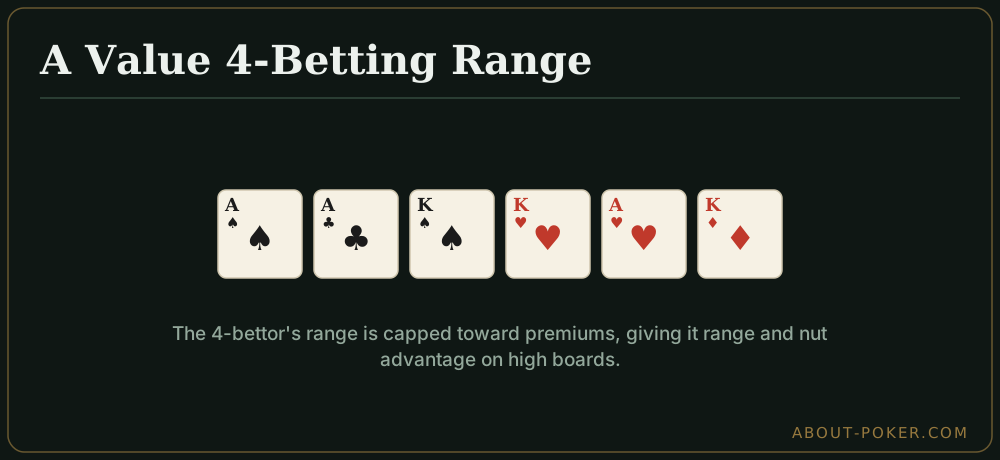
The 4-bettor almost always holds the stronger, more defined range. A value 4-betting range is anchored by AA, KK, QQ, and AK, sometimes with a few suited-ace bluffs like A5s. The caller’s range is narrower and more defensive, often pocket pairs like JJ and TT plus suited broadways such as AQs and KQs that prefer to call rather than commit.
Because the 4-bettor’s range is so weighted to big cards and pairs, they connect with ace-high and king-high flops extremely well. That is why the 4-bettor can fire a small continuation bet on most boards. The caller must defend carefully and cannot simply fold every time they miss.
A Worked Example
You open KK from the cutoff to 2.5bb. The button 3-bets to 8bb, you 4-bet to 20bb, and the button calls. (Had the button instead re-raised your open directly, that would be a cold 4-bet.) Effective stacks were 100bb, so about 80bb remains and the pot is roughly 41bb. Your SPR is under 2.
The flop comes 9-6-2 rainbow. With an overpair and such a low SPR, this is a routine stack-off. You bet around 12bb; if the button raises, you are calling or shoving with KK almost every time because you cannot fold a top-tier overpair for less than two pot-sized bets total. There simply is not enough money behind to justify a fold. Compare that to a single-raised pot at 100bb deep, where you would proceed far more cautiously against aggression.
Common Mistakes in Four-Bet Pots
The biggest leak is overvaluing marginal hands as the caller. Calling a 4-bet with a hand like AJ and then stacking off on an ace-high flop is a classic trap, because the 4-bettor’s aces are usually better. Defend by understanding you are up against a tight, big-card-heavy range.
The second leak is bluffing too much because the pot looks juicy. Low SPR kills fold equity. When your opponent can commit for one or two bets with top pair, a naked bluff rarely gets through. The third leak is forgetting position: out of position in a 4-bet pot, you should tighten your calling range further, because you will face awkward decisions on every street.
Quick Checklist for Playing a Four-Bet Pot
Before the flop, ask whether your hand wants to be in a 4-bet pot at all. Hands that are dominated by AA-KK-AK play badly here. On the flop, calculate the SPR in your head; below roughly 2, plan to get overpairs and top pair in. As the 4-bettor, remember you have range and nut advantage, so a small c-bet is often correct on high boards. As the caller, play tight, honest, and be willing to fold when a raise represents the exact hands your opponent is supposed to have. Master these pots and you will stop bleeding chips in the spots where the most money moves at once.
Frequently asked
What is a four-bet pot in poker?
A four-bet pot is a hand where the preflop betting went raise, re-raise (3-bet), and re-re-raise (4-bet), with a caller or all-in following. Because so much money went in before the flop, the pot is large and the stack-to-pot ratio is low.
Who has the range advantage in a 4-bet pot?
Usually the 4-bettor. Their range is capped toward premium hands like AA, KK, QQ, AK and a few bluffs, so it connects strongly with big cards. The caller's range is narrower and more defensive, often built around pocket pairs and suited broadways.
How low is the SPR in a 4-bet pot?
Very low, typically around 1 to 3 in 100bb games. That low stack-to-pot ratio means top pair or an overpair is often enough to commit your stack, and there is little room for multi-street bluffing.